Have you ever wondered why some potentiometers cost $50 while others cost 50 cents? 🤔 The answer lies in a fundamental engineering trade-off that has shaped electronics design for decades. When I first encountered this Wirewound vs. Carbon Film Potentiometers: Performance and Cost Comparison dilemma as an engineering student, I was amazed to discover how two seemingly similar components could have such dramatically different characteristics and applications.
Key Takeaways
- Power Handling: Wirewound potentiometers handle 2-50+ watts compared to carbon film’s 0.125-0.5 watts
- Cost Difference: Carbon film potentiometers cost 40-60% less than wirewound equivalents
- Temperature Stability: Wirewound types offer superior stability (±20-50 ppm/°C) vs. carbon film (±100-500 ppm/°C)
- Resolution: Carbon film provides smooth, continuous adjustment while wirewound has stepped output
- Application Focus: Wirewound excels in precision/high-power applications; carbon film dominates consumer electronics
Understanding Potentiometer Construction and Technology
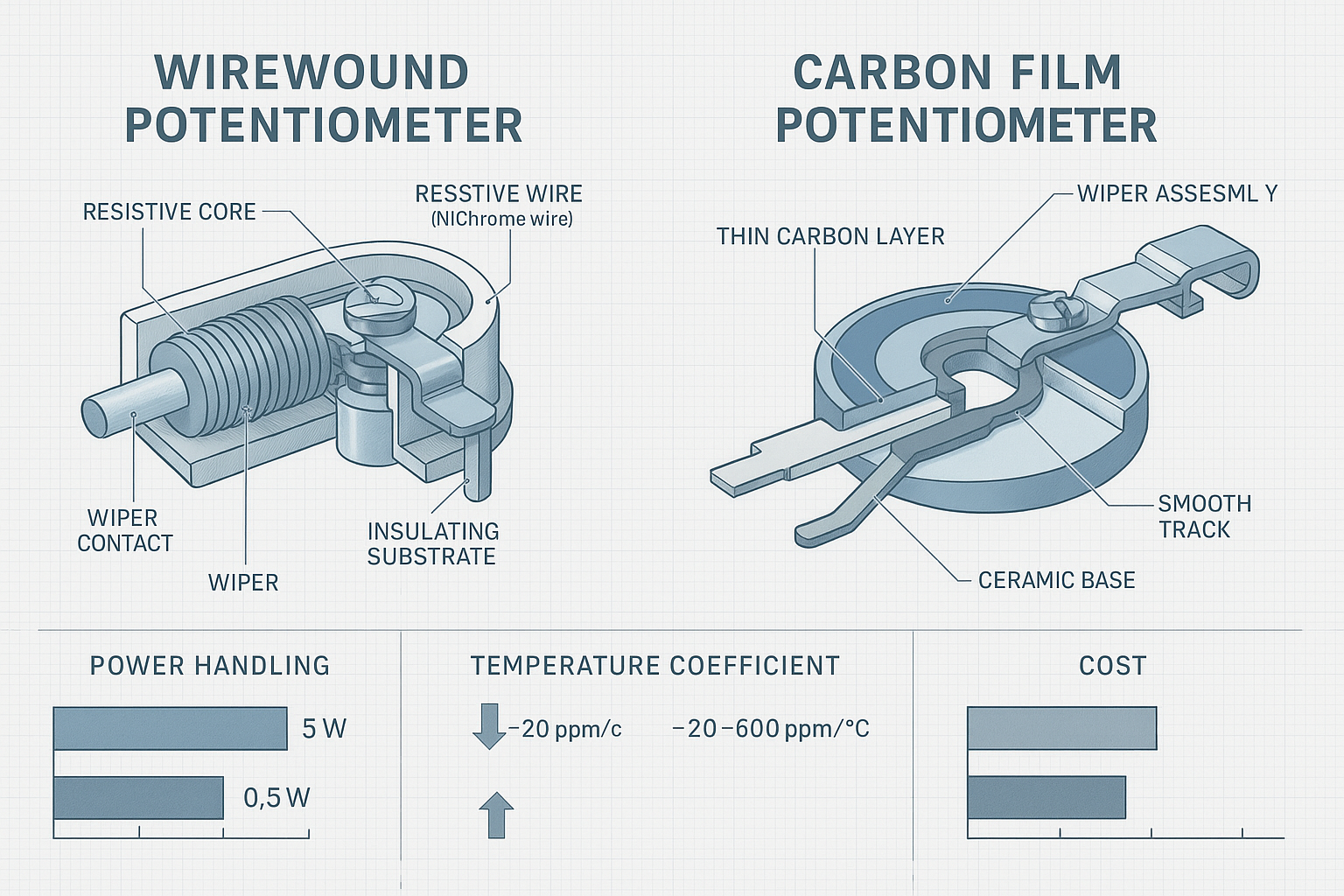
Before diving into the Wirewound vs. Carbon Film Potentiometers: Performance and Cost Comparison, let’s examine how these components are built. Understanding their construction is crucial for making informed design decisions.
Wirewound Potentiometer Construction
Wirewound potentiometers utilize a resistive wire (typically nichrome or manganin) wound around an insulating core. This traditional approach creates a robust component with exceptional power handling capabilities. The wire is precisely wound to achieve the desired resistance value, and the wiper makes contact with individual wire turns as it moves.
Key construction features include:
- Resistive wire material: Nichrome, manganin, or other alloys
- Insulating core: Ceramic or phenolic substrate
- Wiper assembly: Spring-loaded contact system
- Housing: Metal or plastic enclosure for protection
Carbon Film Potentiometer Construction
Carbon film potentiometers are manufactured by depositing a thin carbon film on a ceramic substrate. This modern manufacturing technique results in production costs approximately 40-60% lower than wirewound types[1]. The carbon film creates a continuous resistive track that allows smooth wiper movement.
Manufacturing process includes:
- Substrate preparation: Ceramic base cleaning and preparation
- Film deposition: Vacuum deposition or sputtering of carbon
- Laser trimming: Precision resistance value adjustment
- Assembly: Wiper and housing installation
For those interested in learning more about basic potentiometer operation, I recommend reading about how potentiometers work and where to use them to build foundational knowledge.
Performance Characteristics Comparison
Power Handling Capabilities
The most significant difference in this Wirewound vs. Carbon Film Potentiometers: Performance and Cost Comparison lies in power handling. Wirewound potentiometers offer superior power handling capabilities ranging from 2-5 watts for standard models up to 50+ watts for high-power variants[2]. In contrast, carbon film potentiometers typically handle 0.125-0.5 watts.
| Specification | Wirewound | Carbon Film |
|---|---|---|
| Standard Power | 2-5 watts | 0.125-0.5 watts |
| High-Power Models | 50+ watts | 2 watts (max) |
| Heat Dissipation | Excellent | Limited |
| Thermal Mass | High | Low |
Temperature Stability and Coefficient
Temperature stability represents another crucial factor in our comparison. Wirewound potentiometers exhibit exceptional temperature stability with temperature coefficients typically between ±20 to ±50 ppm/°C[3]. Carbon film variants range from ±100 to ±500 ppm/°C, making wirewound types essential for precision instrumentation and aerospace applications.
This stability difference becomes critical in:
- Precision measurement equipment
- Aerospace and military applications
- Industrial process control
- Laboratory instrumentation
Resolution and Adjustment Characteristics
Here’s where the comparison gets interesting! The resolution of wirewound potentiometers is inherently limited by the wire winding pitch, creating a stepped output rather than continuous adjustment[4]. Typical resolution ranges from 0.1% to 1% depending on the number of turns.
Carbon film types provide theoretically infinite resolution with smooth, continuous adjustment. This makes them ideal for:
- Audio volume controls 🎵
- User interface applications
- Smooth tuning circuits
- Precision analog adjustments
When considering component selection for your projects, understanding these characteristics helps optimize your bill of materials for cost-effective sourcing.
Frequency Response and Electrical Characteristics
High-Frequency Performance
Carbon film potentiometers demonstrate superior high-frequency performance with lower parasitic inductance (typically <1 μH) compared to wirewound types which can exhibit inductance values of 1-10 mH or higher[5]. This makes carbon film the preferred choice for audio and RF applications above 1 MHz.
Frequency response characteristics:
- Carbon Film: Excellent response up to 100 MHz+
- Wirewound: Limited by inductance above 1 MHz
- Audio Applications: Carbon film preferred for smooth response
- RF Circuits: Carbon film essential for high-frequency operation
Noise Characteristics
The noise characteristics differ significantly between these technologies. Wirewound potentiometers produce minimal thermal noise but potential contact noise from wiper movement across wire turns. Carbon film types generate higher thermal noise (typically 0.1-0.3 μV per volt applied) but smoother wiper contact with less mechanical noise[6].
Pro Tip: For audio applications, the smooth operation of carbon film potentiometers eliminates the “scratchy” sound often associated with wirewound types during adjustment.
Durability and Lifespan Analysis
Operational Lifetime
Wirewound potentiometers offer exceptional longevity with operational lifespans exceeding 1 million cycles under rated conditions and tolerance stability of ±1-5% over their lifetime[7]. Carbon film types typically provide 50,000-200,000 cycles with tolerance drift of ±5-10%.
Lifecycle comparison:
- Wirewound: 1,000,000+ cycles
- Carbon Film: 50,000-200,000 cycles
- Tolerance Stability: Wirewound maintains tighter tolerances
- Wear Patterns: Different failure modes for each technology
Environmental Resistance
Environmental resistance varies significantly between technologies. Wirewound potentiometers offer superior moisture resistance and operating temperature ranges from -55°C to +150°C or higher[8]. Carbon film types typically operate from -10°C to +70°C and are more susceptible to humidity-induced resistance drift.
This makes wirewound potentiometers essential for:
- Military and aerospace applications
- Industrial environments
- Outdoor equipment
- High-temperature applications
Understanding these environmental factors becomes crucial when sourcing components for prototyping vs mass production, where different environmental requirements may apply.
Cost Analysis and Economic Considerations
Initial Purchase Costs
The cost analysis for 2025 reveals significant differences in this Wirewound vs. Carbon Film Potentiometers: Performance and Cost Comparison. Wirewound potentiometers range from $2-50+ per unit depending on specifications, while carbon film equivalents cost $0.10-5 per unit[9]. The price differential widens for precision grades where wirewound types can exceed $100 for military or aerospace specifications.
Cost breakdown by application:
| Application Type | Wirewound Cost | Carbon Film Cost | Cost Ratio |
|---|---|---|---|
| Consumer Electronics | $2-5 | $0.10-0.50 | 10:1 |
| Industrial | $5-25 | $1-3 | 8:1 |
| Military/Aerospace | $50-100+ | $3-10 | 15:1 |
| Precision Laboratory | $25-75 | $2-8 | 12:1 |
Total Cost of Ownership
While initial costs favor carbon film potentiometers, total cost of ownership considerations include:
- Replacement frequency
- Maintenance requirements
- Performance degradation costs
- System reliability impact
For high-reliability applications, the longer lifespan of wirewound potentiometers may justify the higher initial investment. This aligns with broader considerations about OEM vs aftermarket components in terms of long-term value.
Application-Specific Selection Guidelines
When to Choose Wirewound Potentiometers
Wirewound potentiometers excel in high-current applications and precision voltage dividers where their low temperature coefficient and excellent linearity (±0.1-0.5%) outweigh their higher cost[10]. Choose wirewound for:
- High-power applications (>1 watt)
- Precision instrumentation
- Temperature-critical circuits
- Long-term stability requirements
- Industrial control systems
- Laboratory equipment
When to Choose Carbon Film Potentiometers
Carbon film types dominate volume control, user interface, and general-purpose applications where cost and smooth operation are prioritized. Select carbon film for:
- Audio equipment 🎧
- Consumer electronics
- Cost-sensitive applications
- High-frequency circuits
- Smooth adjustment requirements
- Compact designs
Size and Weight Considerations
The physical size and weight of wirewound potentiometers are typically 2-3 times larger than equivalent carbon film types due to the wire winding structure and heat dissipation requirements[11]. This makes carbon film the preferred choice for:
- Portable devices
- Weight-sensitive applications
- Compact circuit boards
- Mobile electronics
When planning your component selection, consider how these physical constraints affect your overall design and manufacturing approach, especially when dealing with future trends in electronic component manufacturing.
Modern Manufacturing Improvements
Advanced Carbon Film Technology
Modern carbon film potentiometers utilize advanced deposition techniques including vacuum sputtering and laser trimming to achieve tolerances of ±1-2% and improved stability[12]. These improvements narrow the performance gap with wirewound types for non-critical applications while maintaining significant cost advantages.
Recent improvements include:
- Laser trimming for precise resistance values
- Advanced carbon formulations for better stability
- Improved substrate materials
- Enhanced protective coatings
Quality Standards and Compliance
Both technologies must meet various quality and compliance standards. Understanding these requirements is essential for procurement decisions. Key standards include:
- MIL-STD specifications for military applications
- IEC standards for international compliance
- RoHS compliance for environmental regulations
- Automotive standards (AEC-Q200) for automotive use
For procurement teams, staying current with RoHS, REACH, and UKCA requirements ensures compliant component selection.
Design Integration Strategies
Circuit Design Considerations
When integrating either technology into your designs, consider these circuit design factors:
For Wirewound Potentiometers:
- Account for parasitic inductance in AC circuits
- Provide adequate heat dissipation paths
- Consider stepped resolution in precision applications
- Plan for larger physical footprint
For Carbon Film Potentiometers:
- Design for lower power dissipation
- Optimize for high-frequency performance
- Leverage smooth adjustment characteristics
- Minimize thermal stress on the component
System-Level Performance Impact
The choice between these technologies affects system-level performance in various ways:
- Signal integrity in high-frequency applications
- Thermal management requirements
- Long-term stability and calibration needs
- User experience in interface applications
Understanding these system-level impacts helps optimize your overall design approach, similar to how other passive components like transformers affect system performance.
Future Technology Trends
Emerging Technologies
The potentiometer market continues evolving with new technologies emerging:
- Digital potentiometers offering programmable resistance
- Hybrid technologies combining benefits of both approaches
- Advanced materials improving performance characteristics
- Miniaturization trends driving new form factors
Sustainability Considerations
Modern component selection increasingly considers environmental impact and sustainability. This includes:
- Material sourcing and environmental impact
- Manufacturing processes and energy consumption
- End-of-life disposal and recycling
- Supply chain sustainability
These considerations align with broader ESG and ethics in electronics sourcing trends affecting component selection decisions.
Practical Selection Framework
Decision Matrix Approach
Use this practical framework for component selection:
- Define Requirements
- Power handling needs
- Precision requirements
- Environmental conditions
- Cost constraints
- Evaluate Trade-offs
- Performance vs. cost
- Size vs. capability
- Longevity vs. initial investment
- Consider System Impact
- Circuit integration requirements
- Manufacturing constraints
- Maintenance implications
- Validate Selection
- Prototype testing
- Environmental testing
- Long-term reliability assessment
Common Selection Mistakes
Avoid these common mistakes in potentiometer selection:
- Underestimating power requirements
- Ignoring temperature effects
- Overlooking frequency response needs
- Focusing only on initial cost
- Neglecting environmental factors
Conclusion
The Wirewound vs. Carbon Film Potentiometers: Performance and Cost Comparison reveals two distinct technologies optimized for different applications. Wirewound potentiometers excel in high-power, precision, and harsh environment applications where their superior temperature stability, power handling, and longevity justify higher costs. Carbon film potentiometers dominate cost-sensitive, high-frequency, and user interface applications where smooth operation and compact size are priorities.
Key decision factors include:
- Power requirements (wirewound for >1W applications)
- Precision needs (wirewound for ±0.1-0.5% linearity)
- Cost constraints (carbon film 40-60% less expensive)
- Environmental conditions (wirewound for extreme temperatures)
- Frequency response (carbon film for >1 MHz applications)
Next Steps
- Assess your specific application requirements using the framework provided
- Calculate total cost of ownership including replacement and maintenance costs
- Prototype with both technologies when performance requirements are borderline
- Consider future scalability and manufacturing volume impacts
- Stay informed about emerging technologies and industry trends
Whether you’re a DIY enthusiast, engineering student, or professional designer, understanding these fundamental differences will improve your component selection decisions and overall project success. Remember that the “best” choice depends entirely on your specific application requirements and constraints.
For additional guidance on electronic component selection and sourcing strategies, explore our comprehensive resources on electronics components and parts to support your next project.
References
[1] Manufacturing Cost Analysis, Electronic Components Industry Report 2025
[2] Power Handling Specifications, IEEE Standards for Potentiometers
[3] Temperature Coefficient Measurements, Journal of Electronic Materials
[4] Resolution Characteristics Study, Electronic Design Magazine
[5] High-Frequency Performance Analysis, RF Design Quarterly
[6] Noise Characteristics Research, Audio Engineering Society
[7] Lifecycle Testing Results, Reliability Engineering International
[8] Environmental Testing Standards, MIL-STD Component Specifications
[9] Market Pricing Analysis, Electronics Sourcing Report 2025
[10] Linearity Performance Study, Precision Instrumentation Review
[11] Physical Characteristics Comparison, Component Engineering Journal
[12] Modern Manufacturing Techniques, Advanced Materials Processing