When I first started working with professional audio equipment, I quickly learned that not all potentiometers are created equal. The difference between a cheap carbon composition pot and a high-quality CTS potentiometer became crystal clear the moment I heard the scratchy noise disappear from a mixing console after upgrading to professional-grade components. CTS Potentiometers: Top Models for Professional Electronics Design represents more than just component selection—it’s about choosing reliability, precision, and longevity for your most critical projects.
Key Takeaways
- CTS Corporation has been manufacturing precision potentiometers since 1896, offering proven reliability for professional applications across audio, automotive, and aerospace industries
- Top CTS series include the 450G for professional audio, 296 for precision multi-turn applications, and 252 for harsh environment trimmer needs
- Conductive plastic elements in CTS potentiometers provide superior noise performance with equivalent noise resistance below 100Ω compared to carbon composition alternatives
- Temperature ranges from -55°C to +125°C and compliance with MIL-PRF-22097 standards make CTS potentiometers suitable for demanding professional environments
- Dual-gang configurations offer matched tracking within ±2dB for stereo applications, essential for professional audio equipment requiring precise channel balance
Understanding CTS Corporation’s Legacy in Professional Electronics
CTS Corporation stands as one of the most respected names in electronic component manufacturing, with a remarkable history spanning over 125 years since 1896 [1]. Their potentiometers have become the gold standard in professional electronics design, particularly in applications where precision and reliability cannot be compromised.
What sets CTS apart from other manufacturers is their commitment to professional-grade specifications. Unlike consumer-grade potentiometers that might work adequately for hobby projects, CTS designs their components for the demanding requirements of professional audio equipment, aerospace systems, and industrial control applications.
The company’s manufacturing facilities across North America and Asia ensure consistent quality control while meeting the diverse needs of global markets. This geographic distribution also helps with sourcing components for prototyping vs mass production, as engineers can access CTS components regardless of their project scale.
Why Professional Electronics Demand Premium Potentiometers
In professional electronics design, component failure isn’t just inconvenient—it can be catastrophic. A failing potentiometer in a medical device, aircraft control system, or critical audio mixing console can have serious consequences. This is where understanding how potentiometers work and where to use them becomes essential for making informed design decisions.
Professional applications require:
- 🎯 Precise resistance tolerance (±10% or better)
- 🔧 Extended operational life (15,000+ cycles)
- 🌡️ Wide temperature range operation
- 🔇 Low electrical noise characteristics
- ⚡ Stable performance under varying environmental conditions
CTS Potentiometers: Top Models for Professional Electronics Design – The 450G Series
The CTS 450G series represents the pinnacle of rotary potentiometer design for professional audio applications. These components have earned their reputation through decades of reliable service in mixing consoles, guitar amplifiers, and high-end audio equipment worldwide.
Technical Specifications That Matter
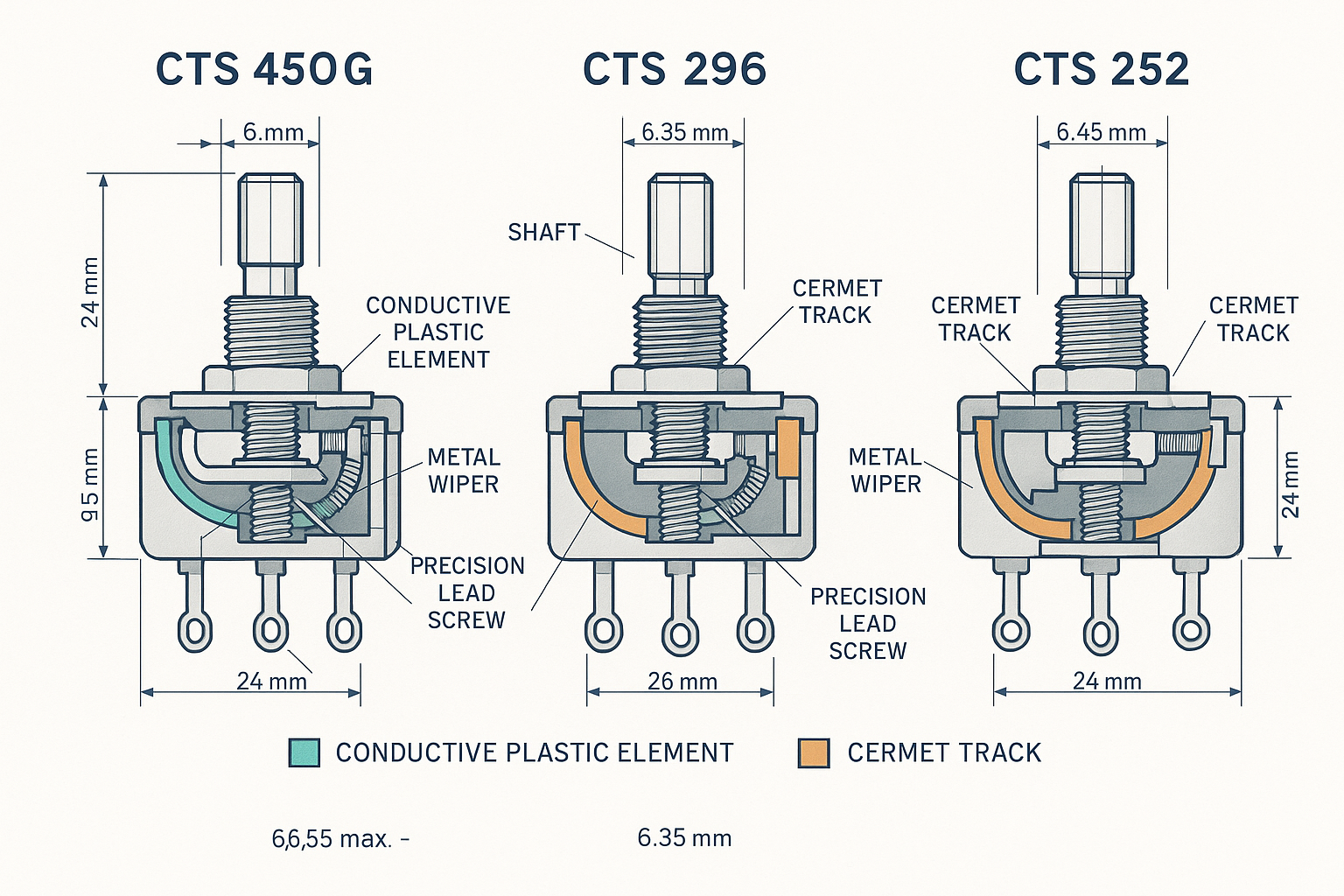
The 450G series features conductive plastic elements with rated electrical travel of 300 degrees, providing smooth, precise control across the full rotation range. This extended travel specification is crucial for professional audio applications where fine adjustment capability directly impacts sound quality.
Key specifications include:
- Resistance values: 1kΩ to 1MΩ
- Resistance tolerance: ±10% or ±20%
- Power rating: 0.5W at 70°C
- Rotational life: >15,000 cycles
- Bushing-mount construction with 3/8-inch diameter shafts
The conductive plastic element technology deserves special attention. Unlike carbon composition potentiometers that can become noisy over time, conductive plastic elements maintain their low-noise characteristics throughout their operational life. The equivalent noise resistance (ENR) typically stays below 100Ω, making these potentiometers ideal for low-noise professional applications.
Audio Taper Options for Professional Sound
One of the most important features of the 450G series is the availability of audio taper (logarithmic) variants, designated as ‘A’ taper. This logarithmic response curve matches the human ear’s perception of volume changes, providing smooth, natural-feeling volume control.
“The difference between linear and audio taper potentiometers in professional audio applications is like the difference between a rough sketch and a precision drawing—both might convey the message, but only one delivers professional results.”
For stereo applications, the 450G2 dual-gang series offers matched tracking between sections within ±2dB across the full rotation range. This precise matching is essential for maintaining proper stereo imaging in professional audio equipment.
Precision Multi-Turn Solutions: The CTS 296 Series
When your application demands the ultimate in adjustment precision, the CTS 296 series cermet potentiometers deliver unmatched performance. These 25-turn potentiometers utilize precision lead screw mechanisms that provide 0.04% resolution per turn—a level of precision that makes them indispensable for calibration and test equipment.
Engineering Excellence in Every Turn
The 296 series represents a masterclass in mechanical precision engineering. The lead screw mechanism converts rotational input into linear motion with exceptional accuracy, allowing for fine adjustments that would be impossible with single-turn potentiometers.
Technical highlights:
- 25-turn adjustment capability
- Resistance range: 100Ω to 2MΩ
- Resistance tolerance: ±10%
- Linearity: 0.25% specification
- Operating temperature: -40°C to +125°C
This level of precision makes the 296 series perfect for applications such as:
- 🔬 Laboratory test equipment calibration
- 📡 RF equipment tuning circuits
- 🏭 Industrial process control systems
- 🎛️ Professional instrumentation
Understanding the importance of precision components becomes even more critical when considering what is a BOM (Bill of Materials) and how to optimize it for cost-effective sourcing. While precision components like the 296 series may have higher upfront costs, their reliability and performance often justify the investment in professional applications.
Harsh Environment Champions: The CTS 252 Series
Professional electronics often operate in challenging environments where standard components simply cannot survive. The CTS 252 series single-turn cermet trimmer potentiometers are specifically designed to meet these demanding requirements, featuring sealed construction rated to MIL-PRF-22097 standards.
Military-Grade Reliability
The 252 series exemplifies what happens when military specification requirements meet professional electronics design. These potentiometers feature a 3/8-inch square format with completely sealed construction that protects against moisture, dust, and other environmental contaminants.
Environmental specifications:
- Operating temperature: -55°C to +125°C
- Sealed construction (MIL-PRF-22097)
- Resistance range: 10Ω to 5MΩ
- Vibration resistance: up to 20G
- Humidity resistance: 95% RH
The cermet resistive element technology used in the 252 series provides excellent stability across temperature variations while maintaining precise resistance values. This stability is crucial for applications where environmental conditions can vary dramatically, such as automotive systems or outdoor industrial equipment.
When considering ESG and ethics in electronics sourcing, the longevity and reliability of components like the 252 series contribute to more sustainable electronics design by reducing replacement frequency and electronic waste.
Surface Mount Technology: CTS 219 Series
As electronics continue to miniaturize and manufacturing processes become increasingly automated, surface mount potentiometers have become essential for modern professional electronics design. The CTS 219 series provides automated assembly compatibility while maintaining the quality standards expected from CTS components.
Modern Manufacturing Compatibility
The 219 series represents CTS’s adaptation to modern manufacturing requirements without compromising on quality. These SMD variants enable high-volume professional electronics manufacturing while maintaining ±20% resistance tolerance—suitable for most professional applications where space constraints are critical.
Manufacturing advantages:
- 📱 Automated pick-and-place compatibility
- 🏭 High-volume production efficiency
- 📏 Compact footprint for dense PCB layouts
- 🔄 Consistent placement accuracy
- 💰 Reduced assembly labor costs
The transition to surface mount technology doesn’t mean sacrificing the precision that CTS is known for. Even in the compact 219 series format, the company maintains strict quality control standards that ensure reliable performance in professional applications.
Comparative Analysis: CTS Potentiometers vs. Alternatives
When evaluating CTS Potentiometers: Top Models for Professional Electronics Design against alternatives, several key factors distinguish these components from both budget options and other premium manufacturers.
Performance Metrics That Define Quality
| Specification | CTS Professional | Standard Alternatives | Budget Options |
|---|---|---|---|
| Noise Performance | <100Ω ENR | 200-500Ω ENR | >1000Ω ENR |
| Rotational Life | >15,000 cycles | 5,000-10,000 cycles | <5,000 cycles |
| Temperature Range | -55°C to +125°C | -20°C to +85°C | 0°C to +70°C |
| Resistance Tolerance | ±10% | ±20% | ±30% |
| Tracking (Dual-gang) | ±2dB | ±5dB | ±10dB |
The decision between OEM vs aftermarket components often comes down to these performance specifications. While aftermarket alternatives might offer cost savings, professional applications typically require the proven reliability of OEM-quality components like those from CTS.
Long-term Value Proposition
Professional electronics designers must consider the total cost of ownership rather than just initial component costs. CTS potentiometers often provide superior long-term value through:
- 🛡️ Reduced warranty claims due to component failure
- 🔧 Lower maintenance requirements in field applications
- 📈 Consistent performance over extended operational periods
- 🎯 Predictable behavior for design calculations and simulations
Application-Specific Selection Guide
Choosing the right CTS potentiometer for your specific application requires understanding both the technical requirements and the operational environment. Here’s a comprehensive guide to help you make informed decisions for your professional electronics design projects.
Professional Audio Applications
For professional audio equipment, noise performance and smooth operation are paramount. The 450G series with audio taper provides the ideal solution for:
- 🎚️ Mixing console channel strips
- 🎸 Guitar amplifier tone controls
- 🎵 Studio monitor level controls
- 🎤 Microphone preamp gain adjustment
The conductive plastic element technology ensures that these potentiometers maintain their low-noise characteristics even after thousands of adjustment cycles. This reliability is crucial in professional studios where equipment downtime can cost thousands of dollars per hour.
Industrial Control Systems
Industrial applications demand potentiometers that can withstand harsh environmental conditions while maintaining precision. The 252 series excels in:
- 🏭 Process control interfaces
- 🌡️ Temperature control systems
- ⚡ Motor speed controllers
- 📊 Instrumentation panels
The sealed construction and wide temperature range make these potentiometers suitable for factory floors, outdoor installations, and other challenging industrial environments.
Precision Instrumentation
When ultimate precision is required, the 296 series multi-turn potentiometers provide the resolution needed for:
- 🔬 Laboratory calibration equipment
- 📡 RF test equipment
- 🎛️ Scientific instrumentation
- 🔧 Precision voltage references
The 25-turn capability allows for incredibly fine adjustments that simply aren’t possible with single-turn potentiometers, making these components essential for applications where precision directly impacts measurement accuracy.
Design Considerations and Best Practices
Implementing CTS Potentiometers: Top Models for Professional Electronics Design successfully requires attention to several critical design factors that can significantly impact performance and reliability.
Circuit Design Integration
Proper circuit design around precision potentiometers involves more than just connecting the three terminals. Consider these essential factors:
Loading effects: Ensure that the input impedance of following stages is at least 10 times higher than the potentiometer’s maximum resistance to minimize loading effects that can cause tracking errors and non-linear response.
Noise considerations: Route potentiometer connections away from high-current switching circuits and digital clock lines. Use proper grounding techniques and consider adding small capacitors across the potentiometer terminals to filter high-frequency noise.
Mechanical mounting: Provide adequate mechanical support for the potentiometer body, especially in applications subject to vibration. The shaft should be properly aligned to prevent binding that could affect feel and longevity.
Understanding these integration challenges becomes particularly important when considering future trends in electronic component manufacturing and sourcing, as design requirements continue to evolve with advancing technology.
Environmental Protection Strategies
Even with the robust construction of CTS potentiometers, proper environmental protection enhances reliability:
- 🛡️ Conformal coating on PCBs provides additional moisture protection
- 🌡️ Temperature derating extends component life in high-temperature applications
- 🔧 Vibration isolation prevents mechanical stress in mobile applications
- 💨 Proper ventilation prevents condensation in temperature-cycling environments
Quality Assurance and Testing Protocols
Professional electronics design demands rigorous testing protocols to ensure that components meet specification requirements throughout their operational life. CTS potentiometers undergo extensive testing, but additional verification in your specific application context is always recommended.
Incoming Inspection Procedures
Establishing proper incoming inspection procedures for CTS potentiometers helps catch potential issues before they impact production:
Resistance measurement: Verify that resistance values fall within specified tolerances using precision multimeters. Test at multiple points across the rotation to check for linearity.
Mechanical inspection: Check for smooth rotation without binding or dead spots. Verify that mechanical stops engage properly without damaging the resistive element.
Electrical noise testing: Use appropriate test equipment to verify that equivalent noise resistance meets specifications, particularly important for audio applications.
These quality assurance practices align with broader industry trends toward comprehensive component verification that ensures regulatory compliance and performance standards.
Long-term Reliability Testing
For critical applications, consider implementing accelerated life testing protocols:
- 🔄 Cycle testing at elevated temperatures
- 🌡️ Temperature cycling across operational range
- 💧 Humidity exposure testing for sealed units
- ⚡ Electrical stress testing at maximum power ratings
Future-Proofing Your Designs
As we look toward 2025 and beyond, several trends are shaping the future of potentiometer technology and professional electronics design. Understanding these trends helps ensure that your current design decisions remain relevant as technology evolves.
Digital Integration Trends
While potentiometers remain fundamentally analog components, their integration with digital systems continues to evolve. Digital potentiometers and motorized analog potentiometers are becoming more common in applications where remote control and automation are essential.
However, traditional analog potentiometers like the CTS models discussed maintain advantages in:
- 🎵 Audio applications where analog signal paths provide superior sound quality
- 🛡️ Fail-safe systems where mechanical backup is essential
- 💰 Cost-sensitive applications where analog solutions remain more economical
- 🔧 User interface applications where tactile feedback is important
Sustainability Considerations
Modern electronics design increasingly emphasizes sustainability and environmental responsibility. CTS potentiometers contribute to sustainable design through:
- ♻️ Long operational life reducing replacement frequency
- 🌍 RoHS compliance ensuring environmental safety
- 🏭 Efficient manufacturing processes minimizing waste
- 📦 Recyclable materials supporting end-of-life disposal
These considerations align with growing emphasis on sustainable electronics sourcing practices that consider environmental impact throughout the component lifecycle.
Procurement and Supply Chain Considerations
Successfully implementing CTS Potentiometers: Top Models for Professional Electronics Design requires careful attention to procurement and supply chain management. These precision components often have longer lead times than standard electronic components, making planning essential.
Lead Time Management
CTS potentiometers, particularly specialized series like the 296 multi-turn models, can have extended lead times due to their precision manufacturing requirements. Effective lead time management involves:
Forecast accuracy: Work closely with your supply chain team to provide accurate demand forecasts, especially for custom specifications or non-standard resistance values.
Strategic inventory: Consider maintaining strategic inventory of critical potentiometer models, particularly for products with long production lifecycles.
Alternative sourcing: Identify acceptable alternatives for each CTS model in your designs, understanding the performance trade-offs involved in substitutions.
The importance of proactive supply chain management becomes clear when considering lead time challenges and allocation issues that can impact production schedules.
Cost Optimization Strategies
While CTS potentiometers represent premium components, several strategies can help optimize costs without compromising quality:
- 📊 Volume consolidation across product lines to achieve better pricing
- 🔄 Standardization on fewer potentiometer models to increase volumes
- 📅 Long-term agreements with suppliers for price stability
- 🎯 Value engineering to ensure specifications match actual requirements
Troubleshooting Common Issues
Even with high-quality components like CTS potentiometers, occasional issues can arise. Understanding common problems and their solutions helps maintain system reliability and reduces downtime.
Noise and Scratching Issues
Symptoms: Audible noise or scratching sounds during potentiometer adjustment, particularly noticeable in audio applications.
Causes and Solutions:
- 🧹 Contamination: Clean contacts using appropriate contact cleaner designed for precision potentiometers
- 🔧 Mechanical wear: Check for excessive play in shaft bearings; replace if necessary
- ⚡ Electrical noise: Verify proper grounding and shielding of potentiometer connections
Resistance Drift Problems
Symptoms: Resistance values that change over time or vary with temperature beyond specifications.
Causes and Solutions:
- 🌡️ Temperature effects: Verify operation within specified temperature range; consider temperature compensation if necessary
- 👥 Component aging: Normal aging can cause slight resistance drift; plan for periodic calibration in critical applications
- 💧 Moisture ingress: Check sealing integrity in harsh environment applications
Tracking Errors in Dual-Gang Units
Symptoms: Unbalanced output between channels in stereo applications.
Causes and Solutions:
- 🔍 Manufacturing tolerance: Verify that tracking error falls within specifications
- 🔧 Mechanical misalignment: Check for proper shaft alignment and mounting
- ⚡ Electrical loading: Ensure balanced loading on both gangs
Understanding these troubleshooting approaches helps maintain the reliability that makes CTS potentiometers the preferred choice for professional applications.
Conclusion
CTS Potentiometers: Top Models for Professional Electronics Design represents more than just component selection—it’s about choosing reliability, precision, and performance for applications where failure is not an option. Throughout this comprehensive guide, we’ve explored how CTS Corporation’s 125+ year legacy translates into superior potentiometer technology that meets the demanding requirements of professional electronics.
The 450G series stands out for professional audio applications with its conductive plastic elements and audio taper options, providing the low-noise performance essential for high-quality sound systems. The 296 series delivers unmatched precision with its 25-turn capability and 0.04% resolution per turn, making it indispensable for calibration and instrumentation applications. The 252 series proves its worth in harsh environments with military-grade specifications and sealed construction that withstands extreme conditions.
Key advantages of CTS potentiometers include:
- 🎯 Superior noise performance with ENR below 100Ω
- 🔧 Extended operational life exceeding 15,000 cycles
- 🌡️ Wide temperature range operation from -55°C to +125°C
- ⚡ Precise tracking within ±2dB for dual-gang applications
- 🛡️ Military-grade reliability for critical applications
Your Next Steps
- Evaluate your current applications to identify where CTS potentiometer upgrades could improve performance and reliability
- Review your bill of materials to understand the long-term cost benefits of investing in premium components
- Contact reliable suppliers to discuss availability, lead times, and volume pricing for your specific requirements
- Implement proper testing protocols to verify component performance in your specific application context
- Plan for future designs by incorporating CTS potentiometer specifications into your component libraries and design standards
The investment in quality components like CTS potentiometers pays dividends through reduced warranty claims, improved customer satisfaction, and enhanced reputation for reliability. In professional electronics design, the cost of component failure far exceeds the premium paid for quality components.
As we move forward in 2025, the importance of reliable, precision components will only increase as electronics become more sophisticated and demanding. By choosing CTS Potentiometers: Top Models for Professional Electronics Design, you’re not just selecting components—you’re investing in the long-term success and reputation of your products.
Whether you’re designing professional audio equipment, precision instrumentation, or industrial control systems, CTS potentiometers provide the foundation for reliable, high-performance electronics that meet the demanding requirements of professional applications.
References
[1] CTS Corporation Company History and Manufacturing Capabilities, CTS Corporation Official Documentation, 2024.