Picture this: you’re deep into your latest electronics project, and you need precise control over resistance. You reach for a potentiometer, but suddenly you’re faced with a choice that could make or break your design. Should you go with the tried-and-true linear potentiometer or embrace the digital revolution with a solid-state alternative? Understanding Digital vs. Linear Potentiometers: Which Type Fits Your Application? isn’t just about picking components—it’s about choosing the right tool that will determine your project’s performance, reliability, and future scalability.
Key Takeaways
- Linear potentiometers provide continuous, infinite resolution analog output but suffer from mechanical wear and environmental sensitivity
- Digital potentiometers offer programmable control and superior reliability but are limited by their fixed resolution steps
- Application requirements like precision, durability, cost, and control method should drive your selection between these two technologies
- Environmental factors such as vibration, dust, and temperature significantly favor digital solutions in harsh conditions
- Integration complexity varies dramatically, with linear pots offering plug-and-play simplicity while digital variants require microcontroller programming
Understanding the Fundamentals: What Makes Each Type Unique?
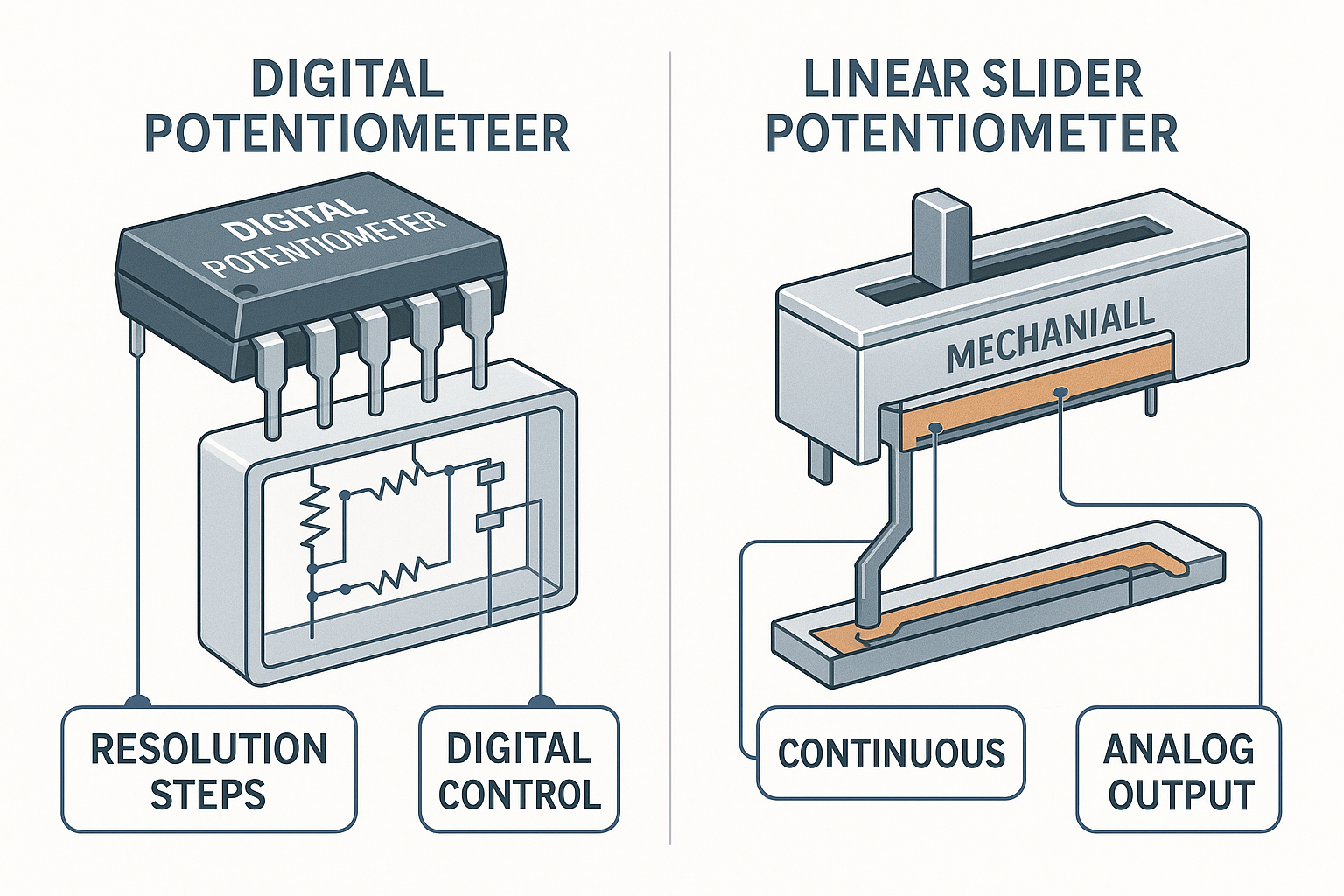
When diving into the world of variable resistance, it’s crucial to understand that linear and digital potentiometers operate on completely different principles. Linear potentiometers are analog devices that use a physical wiper moving along a resistive track to create variable resistance. Think of them as the electronic equivalent of a sliding volume control—smooth, continuous, and intuitive.
On the other hand, digital potentiometers (often called “digipots”) are solid-state integrated circuits that simulate variable resistance through an internal network of resistors and electronic switches. Instead of physical movement, they respond to digital commands sent via communication protocols like SPI or I2C.
The fundamental difference lies in their output characteristics. Linear potentiometers provide theoretically infinite resolution limited only by electrical noise and mechanical precision. Digital potentiometers offer discrete steps determined by their internal architecture—typically ranging from 32 to 1,024 positions.
For students and DIY enthusiasts, this distinction becomes critical when considering how potentiometers work and where to use them in your projects. The choice between continuous analog control and stepped digital control can dramatically impact your circuit’s behavior.
Technical Specifications: Breaking Down the Numbers
Resolution and Precision
Linear potentiometers shine in applications requiring smooth, continuous adjustment. Their resolution is limited only by:
- Mechanical tolerances (typically ±0.1% to ±1% linearity)
- Electrical noise in the measurement system
- Physical wear of the wiper contact
Digital potentiometers offer fixed resolution based on their bit architecture:
- 6-bit: 64 discrete positions
- 8-bit: 256 discrete positions
- 10-bit: 1,024 discrete positions
- Higher resolutions: Some specialized models offer 12-bit or more
Power Consumption Comparison
| Parameter | Linear Potentiometers | Digital Potentiometers |
|---|---|---|
| Static Current | Continuous through resistor | Microamps (µA) |
| Operating Current | 1-50mA depending on value | 1-5mA during switching |
| Standby Mode | Not available | Ultra-low power shutdown |
| Battery Life Impact | Significant drain | Minimal impact |
This power efficiency makes digital potentiometers particularly attractive for battery-powered projects and IoT applications where every microamp counts.
Environmental Resilience: Durability in Real-World Conditions
One of the most significant advantages of digital potentiometers lies in their environmental resilience. Linear potentiometers face several challenges:
Mechanical Wear Issues
- Wiper contact degradation after 100,000 to 1 million cycles
- Dust and debris causing noise and intermittent contact
- Vibration-induced positioning errors
- Moisture ingress leading to corrosion
Temperature Stability
Both types exhibit temperature coefficients, but their behavior differs:
- Linear potentiometers: 50-100 ppm/°C for high-quality models
- Digital potentiometers: 35-100 ppm/°C depending on internal resistor technology
“In harsh industrial environments, the absence of moving parts in digital potentiometers can mean the difference between a system that runs for years versus one that requires frequent maintenance.” – Electronics Design Engineer
For projects requiring long-term reliability, especially in challenging environments, digital solutions often prove superior. This reliability factor becomes crucial when considering sourcing components for prototyping vs mass production, where field failure rates directly impact product success.
Control and Integration: Programming vs. Plug-and-Play
Linear Potentiometer Integration
Linear potentiometers offer immediate simplicity:
- Direct analog output requiring only ADC conversion
- No programming or communication protocols needed
- Real-time response with zero latency
- Compatible with any analog input system
Digital Potentiometer Integration
Digital potentiometers require more complex integration but offer powerful features:
Communication Protocols:
- SPI: High-speed, multiple device control
- I2C: Two-wire interface, address-based selection
- Up/Down: Simple increment/decrement control
- Parallel: Direct digital word input
Advanced Features:
- 🔄 Non-volatile memory for settings retention
- 📊 Multiple wiper configurations (dual, quad channels)
- 🔒 Write protection for critical settings
- ⚡ Programmable shutdown modes
The programming complexity might seem daunting initially, but it opens doors to sophisticated control schemes impossible with linear alternatives. When building complex systems, understanding how to use integrated circuits (ICs) in projects becomes essential for leveraging these advanced capabilities.
Cost Analysis: Initial Investment vs. Long-Term Value
Upfront Costs (2025 Pricing)
Linear Potentiometers:
- Basic models: $1-5
- Precision types: $10-20
- Industrial/sealed versions: $25-100+
Digital Potentiometers:
- Basic IC packages: $1-10
- Multi-channel devices: $5-25
- High-resolution models: $15-50+
Total Cost of Ownership
While initial costs may seem comparable, consider these factors:
Linear Potentiometers:
- ❌ Replacement costs due to wear
- ❌ Calibration maintenance
- ❌ Environmental protection requirements
- ❌ Manual adjustment labor
Digital Potentiometers:
- ✅ Virtually maintenance-free operation
- ✅ Remote calibration capabilities
- ✅ Automated adjustment reducing labor
- ✅ Integration with existing digital systems
When planning your bill of materials (BOM) optimization, these long-term considerations often tip the scales toward digital solutions for commercial applications.
Application-Specific Recommendations
Choose Linear Potentiometers When:
🎵 Audio Applications
- Volume controls requiring smooth adjustment
- Tone controls where infinite resolution matters
- Guitar/instrument controls for musical expression
- Professional audio mixing consoles
⚡ High-Speed Control Systems
- Real-time feedback loops requiring sub-millisecond response
- Analog servo systems
- RF tuning circuits
- Oscilloscope controls
💰 Budget-Conscious Projects
- Simple DIY electronics where cost is paramount
- Educational demonstrations
- Prototype circuits requiring quick implementation
- Single-use or short-term applications
Choose Digital Potentiometers When:
🤖 Microcontroller-Based Systems
- Arduino, Raspberry Pi, and embedded projects
- IoT devices requiring remote adjustment
- Automated calibration systems
- Smart home applications
🏭 Industrial Applications
- Process control systems
- Automotive electronics
- Medical equipment requiring precision and reliability
- Aerospace applications with strict reliability requirements
🔋 Battery-Powered Devices
- Portable instruments
- Wireless sensors
- Mobile measurement devices
- Energy harvesting applications
The choice between these technologies often aligns with broader trends in electronic component manufacturing and sourcing, where digital solutions increasingly dominate due to their integration advantages.
Design Considerations and Best Practices
Linear Potentiometer Design Tips
Mechanical Considerations:
- Select appropriate taper (linear vs. logarithmic) for your application
- Consider shaft length and mounting requirements
- Specify appropriate IP rating for environmental protection
- Plan for periodic cleaning and maintenance access
Electrical Design:
- Include buffer amplifiers to prevent loading effects
- Add filtering to reduce wiper noise
- Consider temperature compensation for critical applications
- Implement proper grounding to minimize interference
Digital Potentiometer Design Guidelines
Communication Interface Design:
- Isolate digital control lines from analog signals
- Implement proper pull-up resistors for I2C interfaces
- Consider SPI vs. I2C based on speed and complexity requirements
- Plan for firmware updates and calibration procedures
Power Supply Considerations:
- Provide clean, stable supply voltages
- Implement proper decoupling capacitors
- Consider separate analog and digital supply domains
- Plan for shutdown and wake-up sequences
Software Architecture:
- Implement non-volatile storage for critical settings
- Design user interfaces for easy adjustment
- Include diagnostic and self-test capabilities
- Plan for remote monitoring and control
When implementing these designs, consider the broader context of component compliance and verification to ensure your chosen solution meets all regulatory requirements.
Future-Proofing Your Design Choice
As we progress through 2025, several trends are shaping the potentiometer landscape:
Digital Integration Advantages
- IoT Connectivity: Digital potentiometers integrate seamlessly with connected systems
- Machine Learning: Automated adjustment algorithms benefit from digital control
- Predictive Maintenance: Digital systems can monitor their own performance
- Remote Diagnostics: Cloud-based monitoring and adjustment capabilities
Sustainability Considerations
The electronics industry increasingly emphasizes ESG and ethics in electronics sourcing, making component longevity and reliability crucial factors. Digital potentiometers’ extended lifespan and reduced maintenance requirements align well with sustainable design practices.
Technology Evolution
- Higher Resolution: New digital architectures offering 16-bit and beyond
- Lower Power: Advanced CMOS processes reducing power consumption further
- Integration: Combined sensor and adjustment functions in single packages
- Wireless Control: Bluetooth and WiFi-enabled adjustment capabilities
Troubleshooting Common Issues
Linear Potentiometer Problems
Scratchy or Noisy Output:
- Clean contacts with appropriate contact cleaner
- Check for worn wiper or track damage
- Verify proper grounding and shielding
- Consider replacement if wear is excessive
Intermittent Operation:
- Inspect for loose mechanical connections
- Check for dust or debris in the track
- Verify proper mounting and alignment
- Test across full range of motion
Digital Potentiometer Challenges
Communication Errors:
- Verify correct protocol timing and voltage levels
- Check pull-up resistors on I2C lines
- Confirm proper chip select timing for SPI
- Use oscilloscope to verify signal integrity
Unexpected Resistance Values:
- Confirm correct digital code calculations
- Check for proper power supply voltages
- Verify temperature compensation settings
- Review datasheet for specific device characteristics
Understanding these common issues helps in making informed decisions about Digital vs. Linear Potentiometers: Which Type Fits Your Application? based on your team’s troubleshooting capabilities and maintenance preferences.
Making the Final Decision
The choice between digital and linear potentiometers ultimately depends on weighing multiple factors specific to your application:
Decision Matrix
| Factor | Linear Advantage | Digital Advantage |
|---|---|---|
| Initial Cost | ✅ Lower for basic models | ❌ Higher complexity |
| Resolution | ✅ Infinite (analog) | ❌ Limited by bits |
| Reliability | ❌ Mechanical wear | ✅ Solid-state |
| Integration | ✅ Simple analog | ❌ Requires programming |
| Maintenance | ❌ Regular required | ✅ Virtually none |
| Environmental | ❌ Sensitive | ✅ Robust |
| Power Efficiency | ❌ Continuous draw | ✅ Ultra-low power |
| Remote Control | ❌ Not possible | ✅ Full capability |
Questions to Ask Yourself
- Will this device operate in a harsh environment? (Digital favored)
- Do I need infinite resolution for smooth control? (Linear favored)
- Is remote or automated adjustment required? (Digital favored)
- Is simplicity more important than features? (Linear favored)
- Will this be a high-volume production item? (Digital often favored for reliability)
For students and DIY enthusiasts just starting their journey, I recommend beginning with linear potentiometers to understand fundamental analog concepts, then progressing to digital solutions as your programming skills develop. This progression mirrors the natural evolution from basic electronics to embedded systems design.
When sourcing components for your final design, consider whether OEM vs aftermarket components best serve your application’s reliability and cost requirements.
Conclusion
The question of Digital vs. Linear Potentiometers: Which Type Fits Your Application? doesn’t have a universal answer—it depends entirely on your specific requirements, constraints, and long-term goals. Linear potentiometers excel in applications requiring smooth, continuous control with minimal complexity, making them ideal for audio equipment, simple controls, and educational projects. Digital potentiometers shine in modern embedded systems where programmability, reliability, and remote control capabilities outweigh their increased complexity.
As you move forward with your project, consider these actionable next steps:
- Evaluate your environment: Assess temperature, vibration, dust, and moisture conditions
- Define your resolution needs: Determine if stepped control is acceptable or if continuous adjustment is critical
- Consider your control system: Decide whether analog simplicity or digital integration better fits your architecture
- Calculate total cost of ownership: Factor in maintenance, replacement, and labor costs beyond initial component price
- Plan for the future: Consider whether your application might benefit from remote adjustment or automated calibration
The electronics landscape continues evolving toward digital integration, but analog solutions maintain their place where simplicity and infinite resolution matter most. By understanding the strengths and limitations of each approach, you’ll make informed decisions that serve your projects well both today and in the future.
Whether you’re a student learning the fundamentals or an experienced engineer designing the next generation of electronic systems, the choice between digital and linear potentiometers represents a microcosm of the broader analog-versus-digital decisions that shape modern electronics design.
References
[1] Electronic Component Manufacturers’ Specifications and Datasheets, 2025
[2] IEEE Standards for Electronic Component Testing and Reliability, 2024-2025
[3] Industrial Electronics Application Notes and Design Guidelines, 2025
[4] Semiconductor Industry Association Component Reliability Studies, 2024