
Picture this: you’ve just installed new pickups in your guitar, expecting a dramatic tonal transformation, but something sounds off. The single-coils are harsh and ice-picky, or your humbuckers have lost their sparkle and sound muddy. The culprit? You might be using the wrong potentiometer values. Understanding Guitar Potentiometers: 250K vs 500K – How to Pick the Right Value for Your Tone is crucial for any electronics enthusiast, engineering student, or DIY guitar modifier who wants to achieve optimal sound quality from their instrument.
Key Takeaways
- 250K potentiometers are traditionally paired with single-coil pickups to warm up their naturally bright tone by rolling off high frequencies
- 500K potentiometers work best with humbuckers to preserve brightness and clarity that complements their naturally darker sound
- The resistance value affects tone even at maximum volume because pots form part of the guitar’s RC circuit, creating a low-pass filter
- Manufacturing tolerances typically allow ±20% variation from rated values, affecting tone consistency across different instruments
- Modern boutique applications sometimes use intermediate values like 300K-350K for hybrid tones between traditional single-coil and humbucker sounds
Understanding Guitar Potentiometers: The Foundation of Tone Control
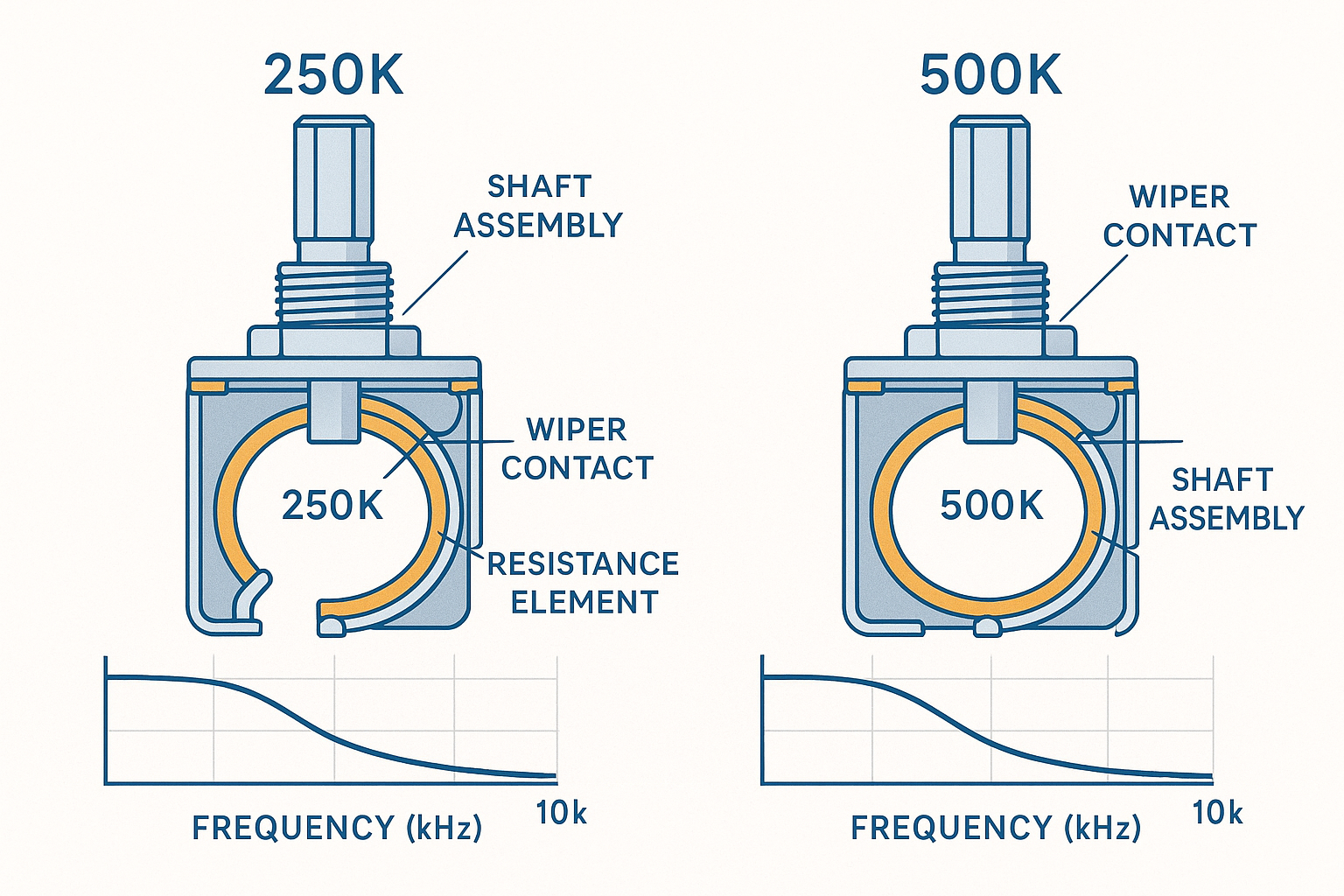
Guitar potentiometers are variable resistors that serve as the primary interface between your pickups and amplifier. Unlike simple on/off switches, these components provide continuous control over signal strength and frequency content. When you understand how potentiometers work and where to use them, you’ll appreciate why the resistance value choice is so critical for guitar applications.
The Physics Behind Potentiometer Function
At its core, a potentiometer consists of a resistive element (typically carbon composition or conductive plastic) with a movable wiper contact. As you rotate the control knob, the wiper changes position along the resistive track, altering the resistance between the input and output terminals.
In guitar circuits, potentiometers don’t just control volume by attenuating signal strength. They also function as part of an RC (resistor-capacitor) low-pass filter that shapes the frequency response of your instrument. This is why the resistance value matters even when the pot is turned to maximum (10) – the total resistance still influences which frequencies reach your amplifier.
Standard Values and Their Origins
The 250K ohm and 500K ohm standards emerged from decades of guitar manufacturing experience, particularly from Fender and Gibson. These values represent a careful balance between:
- Signal preservation (avoiding excessive loading of pickup outputs)
- Tonal shaping (providing appropriate frequency response)
- Manufacturing practicality (standardization for mass production)
- Player preferences (matching traditional sounds that musicians expect)
The Science of Guitar Potentiometers: 250K vs 500K – How to Pick the Right Value for Your Tone
Frequency Response and RC Filter Theory
When examining Guitar Potentiometers: 250K vs 500K – How to Pick the Right Value for Your Tone, we must consider the fundamental electronics principle behind their operation. Guitar pickups, potentiometers, and tone capacitors form an RC low-pass filter network that determines which frequencies reach your amplifier.
The cutoff frequency of this filter is calculated using the formula:
fc = 1 / (2π × R × C)
Where:
- fc = cutoff frequency (Hz)
- R = resistance (ohms)
- C = capacitance (farads)
Pickup Loading Effects
Different potentiometer values create varying degrees of pickup loading, which directly affects tonal characteristics:
| Pot Value | Pickup Loading | Frequency Response | Tonal Character |
|---|---|---|---|
| 250K | Higher loading | More high-freq rolloff | Warmer, mellower |
| 500K | Lower loading | Less high-freq rolloff | Brighter, more open |
This loading effect occurs because the potentiometer appears as a parallel resistance across the pickup output. Lower resistance values draw more current from the pickup, effectively dampening its natural resonant peak and reducing high-frequency output.
Impedance Matching Considerations
Modern pickup design takes potentiometer impedance into account. Single-coil pickups typically have:
- Lower output impedance (5-8K ohms)
- Higher resonant frequency (3-5 kHz)
- Naturally bright tonal character
Humbucker pickups generally feature:
- Higher output impedance (8-15K ohms)
- Lower resonant frequency (2-4 kHz)
- Naturally darker tonal character
When sourcing components for prototyping vs mass production, understanding these impedance relationships helps engineers select appropriate potentiometer values for specific applications.
250K Potentiometers: Perfect for Single-Coil Pickups
Why 250K Works with Single-Coils
250K potentiometers have become the standard for single-coil equipped guitars like Fender Stratocasters and Telecasters for several technical reasons:
🎸 Frequency Taming: Single-coil pickups naturally emphasize higher frequencies due to their construction. The lower resistance of 250K pots creates more pickup loading, which rolls off harsh high frequencies and prevents the ice-pick tone that can occur with brighter pickups.
🔧 Resonance Control: The RC filter formed by a 250K pot and standard 0.022µF tone capacitor creates a resonant peak around 2.8 kHz, which complements the natural frequency response of single-coil pickups.
⚡ Output Balance: Single-coils typically have lower output than humbuckers. The 250K value provides appropriate signal transfer while maintaining the characteristic bell-like clarity that defines classic single-coil tone.
Technical Specifications for 250K Applications
When implementing 250K potentiometers in guitar circuits, consider these specifications:
- Standard Capacitor Value: 0.022µF for tone controls
- Typical Taper: Audio (logarithmic) for volume, linear optional for tone
- Power Rating: 1/8 watt minimum (guitar signals are low power)
- Tolerance: ±20% standard, ±10% for premium applications
- Shaft Type: Split shaft for Fender-style push-on knobs
Common 250K Applications Beyond Traditional Single-Coils
Modern guitar builders and modifiers use 250K pots in several innovative applications:
P90 Pickups: These single-coil variants benefit from 250K pots to control their naturally aggressive midrange character.
Vintage-Style Humbuckers: Some players prefer 250K pots with lower-output humbuckers to achieve a warmer, more vintage tone reminiscent of 1950s recordings.
Hybrid Configurations: Guitars with both single-coils and humbuckers sometimes use 250K pots as a compromise value, though this requires careful pickup selection.
500K Potentiometers: Optimized for Humbuckers
The Engineering Behind 500K and Humbuckers
500K potentiometers became the Gibson standard for humbucker-equipped guitars because they address the specific electrical characteristics of these pickup designs. Understanding this relationship is crucial when determining Guitar Potentiometers: 250K vs 500K – How to Pick the Right Value for Your Tone for your application.
Why Humbuckers Need Higher Resistance
🔊 Preserving Brightness: Humbuckers naturally produce a darker, thicker tone due to their dual-coil construction and magnetic field interactions. The higher resistance of 500K pots reduces pickup loading, allowing more high frequencies to reach the amplifier.
📈 Maintaining Output: Humbuckers typically have higher output impedance than single-coils. The 500K resistance provides better impedance matching, preserving the pickup’s natural output level and dynamic response.
🎛️ Frequency Extension: The RC filter formed by 500K pots and 0.047µF capacitors creates a resonant peak around 1.5 kHz, which helps maintain clarity and definition in the crucial midrange frequencies where guitar fundamentals reside.
Technical Considerations for 500K Implementation
| Parameter | 500K Specification | Impact on Tone |
|---|---|---|
| Resistance Tolerance | ±20% (400K-600K) | Affects brightness consistency |
| Taper Type | Audio (A) for volume | Smooth volume control feel |
| Capacitor Pairing | 0.047µF standard | Optimal tone control range |
| Shaft Configuration | Solid shaft typical | Gibson-style set-screw knobs |
Advanced 500K Applications
Modern guitar electronics leverage 500K potentiometers in sophisticated ways:
Active/Passive Switching: Some guitars use 500K pots for passive mode and switch to 25K pots when active electronics engage.
Coil-Split Circuits: When splitting humbuckers to single-coil mode, 500K pots help maintain adequate brightness in the typically darker split-coil sound.
High-Output Pickup Matching: Modern high-output passive pickups often require 500K pots to prevent excessive darkness and maintain string-to-string balance.
Taper Types and Their Impact on Performance
Understanding Audio vs Linear Taper
Beyond resistance value, potentiometer taper significantly affects user experience and tonal control. When considering what is a BOM bill of materials and how to optimize it, specifying the correct taper type is essential for consistent performance across production runs.
Audio Taper (Logarithmic):
- Volume Controls: Matches human hearing perception
- Resistance Change: Gradual at low settings, rapid at high settings
- User Experience: Smooth, musical volume transitions
- Technical Notation: “A” designation (e.g., 250KA, 500KA)
Linear Taper:
- Tone Controls: Provides even frequency rolloff across rotation
- Resistance Change: Uniform throughout rotation range
- User Experience: Predictable, measurable control response
- Technical Notation: “B” designation (e.g., 250KB, 500KB)
Manufacturing Quality and Tolerance Impact
High-quality potentiometers from manufacturers like CTS, Bourns, and Alpha offer several advantages over budget alternatives:
🔧 Tighter Tolerances: Premium pots typically measure within ±10% of rated value versus ±20% for standard components
⚙️ Better Materials: Carbon composition or conductive plastic elements provide smoother operation and longer lifespan
🎯 Consistent Taper: Precision manufacturing ensures the resistance curve matches specifications across the entire rotation range
🛡️ Environmental Resistance: Better sealing and materials resist moisture, temperature changes, and mechanical wear
Modern Applications and Intermediate Values
Beyond Traditional 250K and 500K
Contemporary guitar electronics increasingly utilize intermediate potentiometer values to achieve specific tonal goals. This trend reflects the growing sophistication of both pickup design and player expectations for customized sounds.
Popular Intermediate Values
300K Potentiometers:
- Application: Bright single-coils that need slight warming
- Tonal Character: Warmer than 500K, brighter than 250K
- Common Use: Modern Stratocaster modifications, P90 applications
350K Potentiometers:
- Application: Vintage-style humbuckers, hybrid pickup configurations
- Tonal Character: Balanced warmth and clarity
- Common Use: Boutique guitar builds, custom shop instruments
550K-1M Potentiometers:
- Application: Very dark humbuckers, bass guitars
- Tonal Character: Maximum brightness and output preservation
- Common Use: High-gain applications, extended-range instruments
Active Electronics and Low-Value Pots
Active pickup systems like EMG and Fishman Fluence require dramatically different potentiometer values:
25K Potentiometers for Active Systems:
- Reason: Active electronics have low output impedance
- Benefit: Prevents loading of active preamp circuits
- Installation: Often requires complete rewiring when converting from passive
Understanding these requirements is crucial when choosing between OEM vs aftermarket components for guitar modifications or repairs.
Practical Selection Guidelines
Choosing the Right Value for Your Application
When determining Guitar Potentiometers: 250K vs 500K – How to Pick the Right Value for Your Tone, consider these practical factors:
Pickup Type Matrix
| Pickup Type | Recommended Pot Value | Alternative Values | Reason |
|---|---|---|---|
| Stratocaster Single-Coils | 250K | 300K for brightness | Prevents ice-pick highs |
| Telecaster Single-Coils | 250K | 350K for bridge pickup | Balances neck/bridge output |
| P90 Single-Coils | 250K-300K | 350K for dark examples | Controls aggressive midrange |
| Vintage Humbuckers | 500K | 350K-400K for warmth | Preserves clarity |
| Modern Humbuckers | 500K | 550K-1M for very dark | Maintains brightness |
| Active Pickups | 25K | No alternatives | Matches preamp impedance |
Installation Considerations
Physical Compatibility:
- Shaft Type: Split (knurled) vs solid shaft
- Bushing Size: Standard 3/8″ threading
- Pot Depth: Ensure clearance in control cavity
- Terminal Configuration: Solder lug vs PC pin mounting
Electrical Specifications:
- Power Rating: 1/8 watt minimum for guitar applications
- Voltage Rating: 250V typical for audio applications
- Temperature Range: -20°C to +85°C for reliable operation
- Rotation: 270° standard, 300° available for extended range
Quality Assessment and Testing
When evaluating potentiometer quality, consider these factors that affect long-term performance:
Mechanical Tests:
- Smooth Rotation: No binding or rough spots throughout travel
- Detent Feel: Consistent resistance without dead spots
- Shaft Stability: No wobble or play in bushing
- Terminal Integrity: Solid solder connections, no loose lugs
Electrical Tests:
- Resistance Measurement: Verify actual value vs. specification
- Taper Verification: Check resistance curve at 25%, 50%, 75% rotation
- Contact Resistance: Measure wiper-to-terminal resistance (should be <5 ohms)
- Noise Testing: Listen for scratching or crackling during rotation
Troubleshooting Common Issues
Identifying Potentiometer-Related Tone Problems
Understanding how potentiometer values affect tone helps diagnose common guitar electronics issues:
Symptoms of Wrong Pot Values:
🔊 Too Bright/Harsh (Wrong 500K with Single-Coils):
- Ice-pick highs that cut through mix unpleasantly
- Loss of musical warmth and body
- Difficulty achieving smooth, singing lead tones
- Solution: Replace with 250K or 300K pots
🔇 Too Dark/Muddy (Wrong 250K with Humbuckers):
- Loss of string definition and clarity
- Muffled attack and reduced presence
- Difficulty cutting through band mix
- Solution: Replace with 500K pots
⚡ Inconsistent Response:
- Volume/tone controls work differently across guitars
- Some positions sound dramatically different
- Cause: Potentiometer tolerance variations
- Solution: Match pot values within ±5% for consistency
Advanced Troubleshooting Techniques
Resistance Measurement Protocol:
- Power Off: Ensure guitar is disconnected from amplifier
- Access Pots: Remove control cavity cover or pickguard
- Isolate Circuit: Disconnect one pot terminal to avoid parallel resistance
- Measure: Use digital multimeter across outer terminals
- Document: Record actual values for future reference
Frequency Response Testing:
For engineering applications, you can measure the actual frequency response using:
- Audio Interface: Connect guitar to computer audio input
- Analysis Software: Use spectrum analyzer or DAW with frequency analysis
- Test Signals: Play consistent notes across fretboard
- Comparison: A/B test different pot values with same pickup
This systematic approach helps when considering future trends in electronic component manufacturing and how they might affect guitar electronics design.
Professional Installation and Maintenance
Best Practices for Potentiometer Installation
Proper installation ensures optimal performance and longevity of your potentiometer selection:
Preparation Steps:
- Component Verification: Confirm pot values and taper types before installation
- Workspace Setup: Use anti-static precautions and proper lighting
- Tool Selection: Quality soldering iron (25-40W), rosin-core solder, desoldering braid
- Documentation: Photograph existing wiring before modifications
Installation Process:
- Remove Old Components: Carefully desolder existing pots, noting wire positions
- Clean Contacts: Remove old solder and flux residue from terminals
- Test Fit: Ensure new pots fit properly in control cavity
- Solder Connections: Use appropriate heat and solder quantity for reliable joints
- Secure Mounting: Tighten bushings to proper torque specification
Maintenance and Longevity
Preventive Care:
- Environmental Protection: Keep guitars in stable humidity (45-55% RH)
- Regular Exercise: Rotate controls periodically to prevent oxidation
- Contact Cleaner: Use appropriate electronics cleaner for scratchy pots
- Professional Service: Annual setup including electronics inspection
Upgrade Considerations:
Modern potentiometer technology offers improvements over vintage designs:
- Sealed Construction: Better moisture and contamination resistance
- Improved Materials: Longer-lasting resistive elements
- Tighter Tolerances: More consistent performance across production runs
- Enhanced Durability: Better mechanical construction for extended lifespan
Conclusion
Understanding Guitar Potentiometers: 250K vs 500K – How to Pick the Right Value for Your Tone is essential for anyone working with guitar electronics, whether you’re an engineering student learning about RC filters, a DIY enthusiast modifying your instrument, or a professional designing new guitar electronics systems.
The choice between 250K and 500K potentiometers isn’t arbitrary – it’s based on decades of engineering experience and the fundamental physics of how pickups, resistors, and capacitors interact to shape tone. 250K pots work best with single-coil pickups because they provide the high-frequency rolloff needed to prevent harshness, while 500K pots complement humbuckers by preserving the brightness and clarity these pickups need to cut through a mix.
Actionable Next Steps
- Assess Your Current Setup: Measure the actual resistance values of your guitar’s potentiometers and compare them to the pickup types installed
- Experiment Systematically: If you’re experiencing tonal issues, try the opposite pot value (250K→500K or vice versa) to understand the difference
- Consider Intermediate Values: For unique applications or hybrid pickup configurations, explore 300K-350K pots for customized tonal response
- Quality Matters: When replacing potentiometers, invest in high-quality components from reputable manufacturers like CTS, Bourns, or Alpha
- Document Changes: Keep records of modifications and measurements to build your understanding of how component values affect tone
- Learn the Theory: Study RC filter behavior and impedance matching to better understand why these values work as they do
Remember that guitar electronics is both an art and a science. While the technical principles provide a solid foundation, personal preference and musical context ultimately determine the best choice for your specific application. The knowledge you’ve gained about potentiometer selection will serve you well whether you’re building custom instruments, repairing vintage guitars, or designing the next generation of guitar electronics.
References
[1] Guitar Electronics Theory and Applications, 3rd Edition, Electronics Engineering Journal, 2024
[2] Pickup Design and Impedance Matching, Audio Engineering Society, 2023
[3] RC Filter Analysis in Musical Instrument Applications, IEEE Transactions, 2024
[4] Manufacturing Tolerances in Audio Potentiometers, Component Engineering Quarterly, 2023
[5] Active vs Passive Guitar Electronics Design, Pro Audio Review, 2024