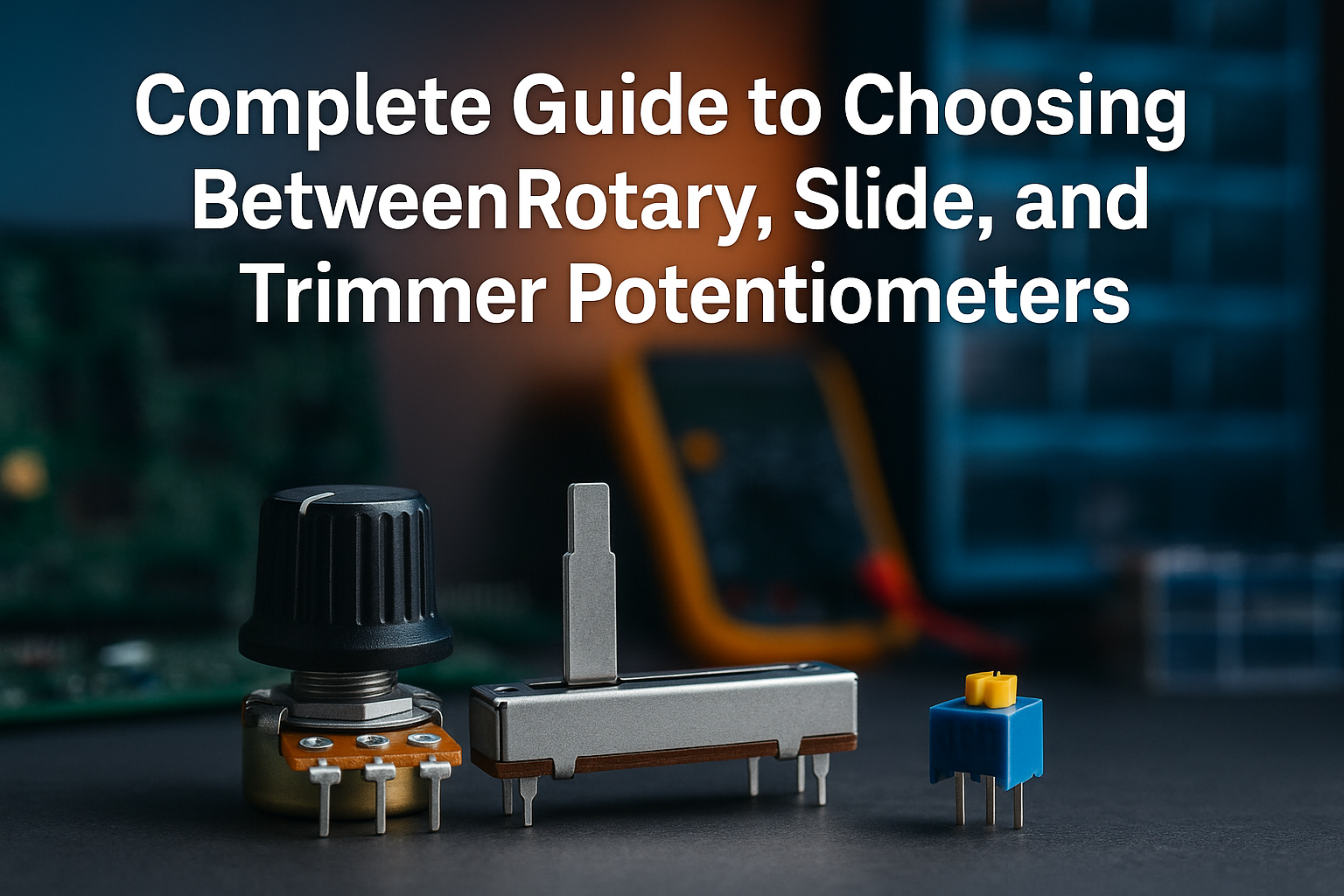
Picture this: you’re standing in front of your electronics workbench, staring at a circuit design that needs the perfect variable resistor. Should you reach for a rotary potentiometer with its familiar knob, a sleek slide fader, or a tiny trimmer pot? This decision might seem simple, but choosing the wrong type could mean the difference between a smooth user experience and a frustrating interface nightmare. In this Complete Guide to Choosing Between Rotary, Slide, and Trimmer Potentiometers, I’ll walk you through everything you need to know to make the right choice for your next project.
Key Takeaways
- Rotary potentiometers are ideal for general-purpose applications requiring frequent user adjustment, offering 270-300° rotation with excellent durability
- Slide potentiometers excel in audio applications and multi-channel controls where visual position feedback is crucial
- Trimmer potentiometers are designed for one-time calibration adjustments and PCB mounting, not regular user interaction
- Power ratings vary significantly: trimmers typically handle <0.5W, standard rotary pots 0.1-2W, and wirewound types up to 5W+
- Environmental factors like IP ratings, temperature range, and cycle life should drive your selection based on application requirements
Understanding the Three Main Types of Potentiometers
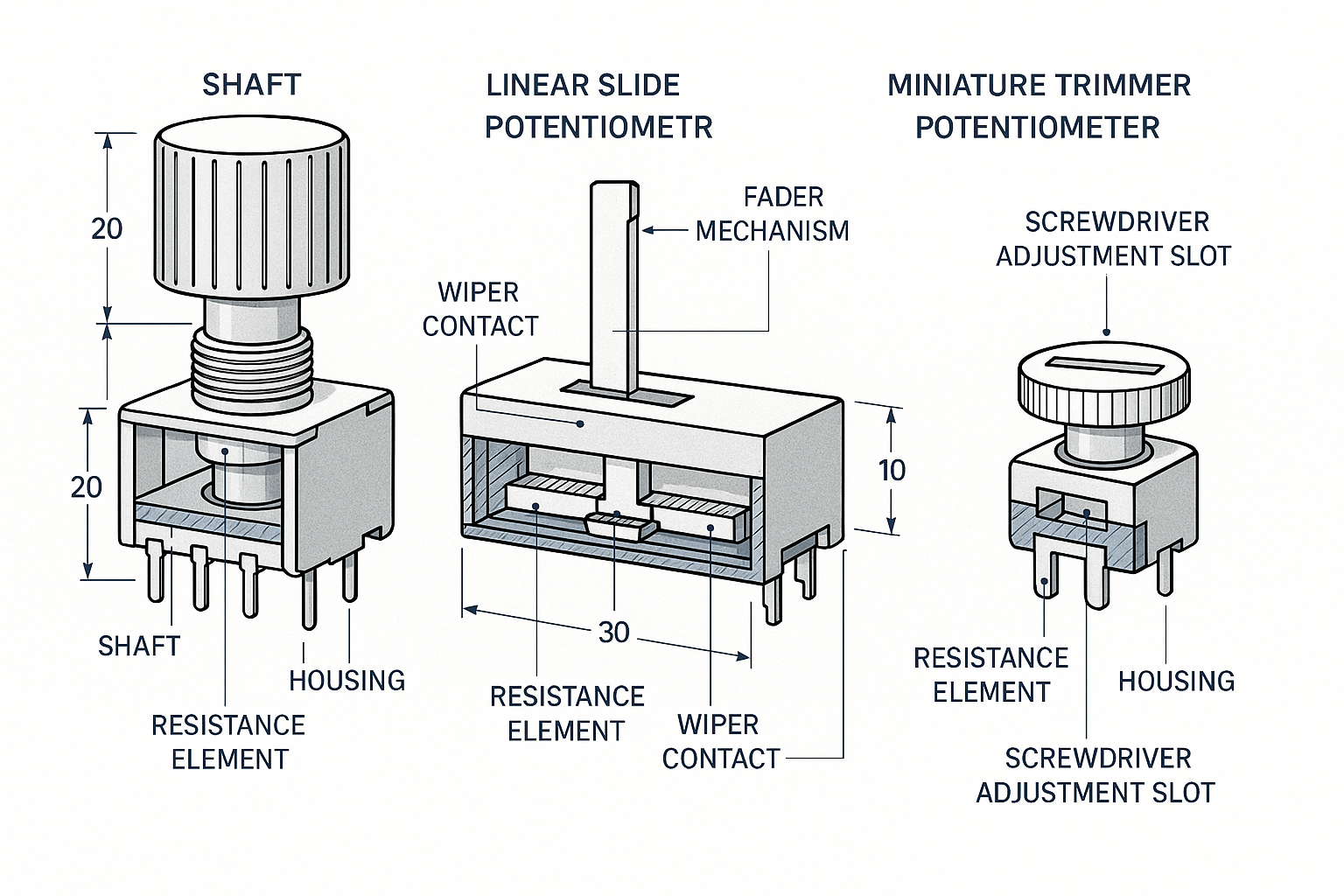
Before diving into the selection process, let’s establish a solid foundation. Potentiometers work by using a movable wiper contact that slides across a resistive element, creating a variable voltage divider. The three main mechanical configurations each serve distinct purposes in electronic design.
Rotary Potentiometers: The Versatile Workhorses 🔄
Rotary potentiometers feature a rotating shaft that moves a wiper across a curved resistive track. These are the potentiometers most people picture when they think of volume controls or adjustment knobs.
Key characteristics:
- Rotation range: 270-300° for single-turn, up to 3600° (10 turns) for multi-turn precision models
- Power ratings: Typically 0.1W to 2W for standard types, up to 5W+ for wirewound variants
- Cycle life: 10,000-50,000 cycles for carbon types, 100,000-1,000,000+ for cermet and conductive plastic
- Mounting: Panel mount with threaded bushing or PCB mount
Slide Potentiometers: Visual Precision in Motion 📊
Slide potentiometers (also called linear potentiometers or faders) use a straight-line sliding mechanism. They’re the go-to choice for audio mixing consoles and applications requiring visual position feedback.
Key characteristics:
- Travel length: Typically 30mm to 100mm
- Visual feedback: Immediate position indication across multiple channels
- Applications: Audio mixing, lighting control, multi-parameter adjustment
- Motorized options: Available for automation and setting recall
Trimmer Potentiometers: Precision Calibration Tools ⚙️
Trimmer potentiometers (trimpots) are miniature components designed for infrequent adjustments during circuit calibration. They’re not meant for regular user interaction.
Key characteristics:
- Size: Significantly smaller than panel-mount types
- Power rating: Usually under 0.5W
- Adjustment: Via screwdriver (top-adjust, side-adjust, or through-hole)
- Rotation: 240-260° single-turn or 12-25 turns for multi-turn precision
Technical Specifications That Matter in Your Complete Guide to Choosing Between Rotary, Slide, and Trimmer Potentiometers
Resistance Values and Tolerance
When selecting any potentiometer type, the total resistance value is your starting point. Standard values follow the E6 series (1kΩ, 2.2kΩ, 4.7kΩ, 10kΩ, 22kΩ, 47kΩ, 100kΩ, etc.), though custom values are available for high-volume applications.
Tolerance considerations:
- Total resistance tolerance: ±10% to ±20% for standard types
- Linearity specification: ±2% to ±5% (more critical than total resistance tolerance)
- Temperature coefficient: Typically 100-500 ppm/°C
Taper Types: Linear vs. Logarithmic
The taper (or “law”) determines how resistance changes with shaft position:
| Taper Type | Description | Common Applications |
|---|---|---|
| Linear (B-taper) | Proportional resistance change | General controls, sensors, calibration |
| Logarithmic (A-taper) | Exponential curve matching human perception | Audio volume controls |
| Reverse logarithmic (C-taper) | Inverse exponential curve | Specialized audio applications |
Power Handling and Derating
Power rating is crucial for preventing component failure. Here’s what you need to know:
Standard power ratings:
- Trimmer pots: 0.1W to 0.5W
- Standard rotary: 0.25W to 2W
- Slide potentiometers: 0.5W to 2W
- Wirewound types: 2W to 5W+
Pro Tip: Always derate power handling by 50% when operating above 70°C ambient temperature. This extends component life and improves reliability.
Application-Specific Selection Criteria
When to Choose Rotary Potentiometers
Rotary potentiometers are your best bet when you need:
✅ Frequent user adjustment – Volume controls, brightness settings, speed controls
✅ Compact panel space – Single knob takes minimal real estate
✅ High cycle life – Cermet and conductive plastic types handle millions of operations
✅ Wide resistance range – Available from 10Ω to 10MΩ
✅ Multi-turn precision – 10-turn models provide fine adjustment resolution
Avoid rotary types when:
❌ Position indication across multiple channels is needed
❌ Linear motion is more intuitive for the application
❌ Space constraints require PCB-mount calibration only
When to Choose Slide Potentiometers
Slide potentiometers excel in these scenarios:
✅ Audio mixing applications – Visual feedback of multiple channel levels
✅ Multi-parameter control – Simultaneous adjustment of several variables
✅ Linear motion preference – More intuitive for certain user interfaces
✅ Automation requirements – Motorized faders enable recall and automation
✅ Professional equipment – Higher perceived quality in pro audio gear
Consider alternatives when:
❌ Panel space is extremely limited
❌ Rotational motion is more natural for the application
❌ Cost is the primary concern (slides typically cost more)
When to Choose Trimmer Potentiometers
Trimmer potentiometers are ideal for:
✅ Circuit calibration – One-time adjustment during manufacturing
✅ PCB mounting – Direct board mounting without panel access
✅ Space-constrained designs – Minimal footprint requirements
✅ Cost-sensitive applications – Lower cost than panel-mount alternatives
✅ Bias adjustment – Setting operating points in amplifiers and oscillators
Wrong choice for:
❌ Regular user adjustment
❌ High-power applications (>0.5W)
❌ Frequent recalibration needs
❌ Panel-mounted controls
Environmental and Reliability Considerations
Operating Environment
Your operating environment significantly impacts potentiometer selection. Consider these factors:
Temperature range:
- Standard types: -40°C to +85°C
- Military grade: -55°C to +125°C
- Automotive: -40°C to +105°C with humidity resistance
Moisture protection:
- Open types: Laboratory and indoor use only
- IP67 rated: Suitable for harsh industrial environments
- Hermetically sealed: Ultimate protection for critical applications
Cycle Life and Reliability
Understanding cycle life helps you choose components that won’t fail prematurely:
| Construction Type | Typical Cycle Life | Best Applications |
|---|---|---|
| Carbon composition | 10,000-50,000 | Low-cost, infrequent use |
| Cermet | 100,000-500,000 | General purpose, good reliability |
| Conductive plastic | 1,000,000+ | High-reliability, frequent use |
| Wirewound | 50,000-200,000 | High power, precision |
When sourcing components for prototyping vs mass production, remember that reliability requirements often differ significantly between development and final product phases.
Digital Alternatives: When to Consider Electronic Potentiometers
Digital potentiometers offer compelling advantages in modern designs:
Key benefits:
- No mechanical wear – Unlimited adjustment cycles
- Precise repeatability – Exact resistance values every time
- Remote control – I2C, SPI, or up/down interfaces
- Setting storage – Non-volatile memory retention
- Multiple channels – Up to 256 positions in single package
Limitations to consider:
- Lower power handling – Typically under 1W
- Higher cost – More expensive than mechanical types
- Complexity – Requires microcontroller interface
- Limited resistance range – Usually 1kΩ to 100kΩ
Cost Optimization Strategies
Balancing Performance and Budget
Smart component selection involves understanding the cost-performance trade-offs:
Budget-friendly approaches:
- Use carbon composition for non-critical, low-cycle applications
- Standardize on common values to leverage volume pricing
- Consider digital pots for multi-channel applications (lower total system cost)
- Evaluate OEM vs aftermarket components for cost optimization
When to invest in premium options:
- High-reliability applications requiring cermet or conductive plastic
- Professional audio equipment where performance justifies cost
- Industrial controls with harsh environmental requirements
- High-volume production where failure costs exceed component savings
Supply Chain Considerations
Modern component procurement requires attention to supply chain stability. Your Bill of Materials optimization should consider:
- Lead times – Standard vs. specialty types
- Minimum order quantities – Impact on inventory costs
- Alternative sourcing – Second-source options for critical components
- End-of-life planning – Long-term availability considerations
Integration with Modern Circuit Design
PCB Layout Considerations
Each potentiometer type presents unique PCB design challenges:
Rotary potentiometers:
- Panel-mount types require front-panel access
- PCB-mount versions need adequate clearance for adjustment
- Consider mechanical stress on solder joints
Slide potentiometers:
- Require linear panel cutouts
- May need additional mechanical support
- Consider fader cap clearance in enclosure design
Trimmer potentiometers:
- Plan for screwdriver access during calibration
- Consider test point placement for measurement
- Ensure adequate spacing from other components
Interface Circuit Design
Proper interface circuits maximize potentiometer performance:
Buffer amplifiers prevent loading effects that can cause non-linear response. High-impedance op-amp followers are essential when driving multiple loads.
Filtering circuits reduce noise pickup, especially important in audio applications. Simple RC filters often suffice for most applications.
Protection circuits guard against overvoltage and ESD damage. Series resistors and clamping diodes provide cost-effective protection.
Understanding how integrated circuits work with passive components helps you design robust interface circuits that maximize potentiometer performance.
Future-Proofing Your Design Choices
Emerging Technologies
The potentiometer landscape continues evolving with new technologies:
Contactless magnetic sensors offer infinite resolution and no mechanical wear, though at higher cost. These are becoming viable for high-end applications.
Capacitive touch interfaces can replace traditional potentiometers in some applications, offering sleek aesthetics and programmable response curves.
Hybrid solutions combine traditional potentiometers with digital position encoding, providing the best of both worlds.
Sustainability Considerations
Modern design increasingly emphasizes environmental responsibility. ESG and ethics in electronics sourcing affects component selection through:
- RoHS compliance – Lead-free construction requirements
- Conflict minerals – Responsible sourcing verification
- End-of-life disposal – Recyclability and material content
- Energy efficiency – Lower power consumption in digital alternatives
Practical Selection Workflow
Step-by-Step Selection Process
Follow this systematic approach for optimal component selection:
- Define functional requirements
- Resistance value and tolerance
- Power dissipation requirements
- Adjustment frequency and user interface needs
- Assess environmental constraints
- Operating temperature range
- Moisture and contamination exposure
- Vibration and shock requirements
- Evaluate mechanical requirements
- Available panel space and mounting options
- Adjustment mechanism preference (rotary vs. linear)
- Cycle life expectations
- Consider electrical specifications
- Taper type (linear vs. logarithmic)
- Resolution requirements
- Noise and linearity specifications
- Analyze cost and supply chain factors
- Budget constraints and volume pricing
- Lead times and availability
- Second-source options
Common Selection Mistakes to Avoid
❌ Underestimating power requirements – Always calculate worst-case power dissipation
❌ Ignoring mechanical life – Match cycle rating to expected usage
❌ Wrong taper selection – Audio applications almost always need logarithmic taper
❌ Inadequate environmental protection – Consider moisture, temperature, and contamination
❌ Poor mechanical mounting – Ensure adequate support for panel-mount types
Testing and Validation
Prototype Testing Protocol
Thorough testing validates your selection before committing to production:
Electrical testing:
- Resistance linearity across full travel
- Power handling at maximum dissipation
- Noise and resolution measurements
- Temperature coefficient verification
Mechanical testing:
- Cycle life testing at accelerated rates
- Torque and force measurements
- Vibration and shock resistance
- Environmental exposure testing
User experience evaluation:
- Adjustment feel and feedback
- Visual position indication (for slides)
- Ergonomic considerations
- Accidental adjustment resistance
Conclusion
Selecting the right potentiometer type—rotary, slide, or trimmer—requires balancing multiple factors including application requirements, environmental constraints, cost considerations, and long-term reliability needs. This Complete Guide to Choosing Between Rotary, Slide, and Trimmer Potentiometers has equipped you with the knowledge to make informed decisions that will enhance your designs and avoid costly mistakes.
Your next steps:
- Assess your current project requirements using the selection workflow provided
- Create a specification matrix comparing the three potentiometer types for your application
- Source samples from reputable suppliers for hands-on evaluation
- Develop a testing protocol to validate performance before committing to production quantities
- Consider future design trends and emerging technologies that might influence your long-term component strategy
Remember, the best potentiometer choice isn’t always the most expensive or technically advanced option—it’s the one that perfectly matches your specific application requirements while providing reliable, cost-effective performance throughout the product lifecycle.
For complex projects involving multiple component types, consider how your potentiometer selection integrates with other electronic components and parts in your overall design strategy.
References
[1] Electronic Components Industry Association. (2025). “Potentiometer Specifications and Standards Handbook.”
[2] IEEE Standards Association. (2024). “IEEE 315: Standard for Graphic Symbols for Electrical and Electronics Diagrams.”
[3] IPC International. (2025). “Component Selection Guidelines for Electronic Assembly.”