
Imagine spending weeks perfecting your electronic circuit design, only to discover that component tolerances have thrown off your carefully calculated values. 🔧 Your amplifier’s gain is slightly off, your voltage reference isn’t quite right, or your filter frequency has drifted from the target specification. This is where Trimmer Potentiometers: Essential Components for Circuit Calibration become your secret weapon, offering the precision adjustment capabilities that transform good circuits into great ones.
In the world of electronics, precision matters. Whether you’re a DIY enthusiast building your first audio amplifier, an engineering student learning circuit design, or working on professional projects, understanding how trimmer potentiometers function as essential components for circuit calibration can make the difference between a circuit that works and one that works perfectly.
Key Takeaways
- Trimmer potentiometers are miniature variable resistors designed specifically for infrequent adjustments during circuit calibration and fine-tuning
- Multiple types available including single-turn, multi-turn, and SMT variants, each offering different levels of precision and mounting options
- Critical for precision applications such as voltage reference adjustment, amplifier gain control, and ADC calibration where accuracy improvements are measurable
- Selection criteria matter including resistance value, power rating, temperature coefficient, and environmental sealing requirements
- Modern alternatives exist with digital potentiometers offering remote calibration capabilities for advanced applications
Understanding Trimmer Potentiometers as Essential Components
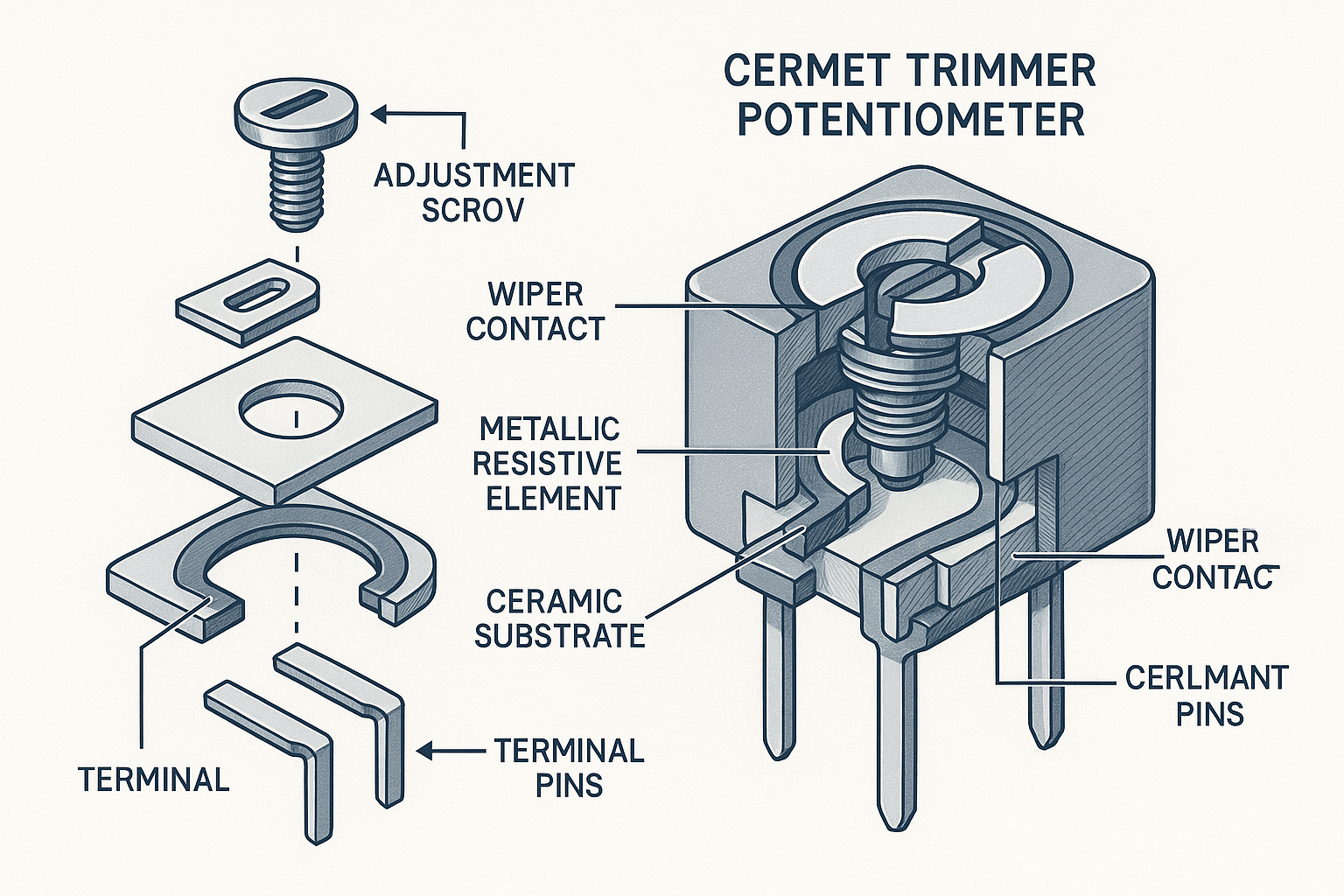
Trimmer potentiometers represent a specialized category of variable resistors engineered for precision and reliability. Unlike the standard potentiometers you might find in audio equipment or user controls, trimmer potentiometers are designed for infrequent adjustment during circuit calibration phases.
These miniature components typically mount directly onto printed circuit boards (PCBs) and require a screwdriver or specialized adjustment tool rather than manual rotation. This design approach serves multiple purposes:
Key Design Features
- Compact form factor suitable for dense PCB layouts
- Tamper-resistant adjustment preventing accidental changes
- High precision with resolution capabilities down to 0.01% in multi-turn variants
- Environmental protection with sealed options for harsh conditions
The global potentiometer market, which encompasses trimmer potentiometers, reached approximately USD 2.1 billion in 2023 and continues growing at a compound annual growth rate (CAGR) of 4.8% through 2030 [1]. This growth reflects increasing demand across automotive electronics, consumer devices, and industrial automation applications.
“Trimmer potentiometers bridge the gap between theoretical circuit design and real-world component tolerances, enabling engineers to achieve the precision their applications demand.”
When sourcing components for prototyping vs mass production, trimmer potentiometers often play different roles. In prototypes, they provide flexibility for experimentation and optimization. In production, they enable calibration to compensate for component variations.
Types and Specifications of Trimmer Potentiometers
Understanding the various types of trimmer potentiometers as essential components for circuit calibration helps you select the right component for your specific application. Each type offers distinct advantages depending on your precision requirements and mounting constraints.
Single-Turn Trimmer Potentiometers
Single-turn trimpots provide 250-270 degrees of rotation, making them suitable for applications requiring:
- Quick adjustments during initial circuit setup
- Coarse tuning where high precision isn’t critical
- Cost-effective solutions for budget-conscious projects
- Space-constrained designs due to their compact size
Multi-Turn Trimmer Potentiometers
For applications demanding higher precision, multi-turn variants offer 3-25 complete rotations:
| Turns | Resolution | Typical Applications |
|---|---|---|
| 3-turn | ~0.1% | Audio equipment, basic instrumentation |
| 10-turn | ~0.03% | Precision amplifiers, measurement devices |
| 25-turn | ~0.01% | Laboratory equipment, high-end audio |
Surface-Mount Technology (SMT) Variants
SMT trimmer potentiometers enable automated assembly processes while maintaining calibration capabilities:
- Automated placement during PCB assembly
- Reduced board space requirements
- Improved reliability through reflow soldering
- Cost efficiency in high-volume production
Cermet vs. Carbon Composition
Cermet (ceramic-metallic) trimmer potentiometers have largely replaced carbon composition types due to superior characteristics:
Cermet Advantages:
- Temperature stability: ±100 ppm/°C
- Low noise characteristics
- Environmental resistance
- Longer operational life
When developing your Bill of Materials (BOM), specifying cermet trimmer potentiometers often provides better long-term value despite higher initial costs.
Applications in Circuit Calibration
Trimmer potentiometers serve as essential components for circuit calibration across numerous electronic applications. Their ability to provide precise, stable adjustments makes them invaluable in both analog and mixed-signal designs.
Voltage Divider Adjustment
In precision voltage reference circuits, trimmer potentiometers enable fine-tuning of output voltages to compensate for:
- Component tolerance variations
- Temperature drift effects
- Aging characteristics
- Load regulation requirements
Amplifier Gain Control
Audio and instrumentation amplifiers frequently incorporate trimmer potentiometers for:
- Gain matching between channels
- Offset nulling in operational amplifier circuits
- Frequency response optimization
- Distortion minimization
Similar to how transformers transfer power with specific turns ratios, amplifiers require precise gain settings that trimmer potentiometers can provide.
ADC and DAC Calibration
In precision analog-to-digital converter (ADC) circuits, trimmer potentiometers enable:
- Reference voltage calibration
- Offset error correction
- Linearity improvements
- Accuracy enhancements from ±1 LSB to ±0.5 LSB in 12-bit and 16-bit systems
Oscillator and Filter Tuning
Frequency-dependent circuits benefit from trimmer potentiometer adjustments for:
- Center frequency setting in active filters
- Oscillator frequency calibration
- Phase-locked loop (PLL) optimization
- Bandwidth control in resonant circuits
Just as crystals and oscillators provide the heartbeat of electronics, trimmer potentiometers fine-tune these timing circuits for optimal performance.
Selection Criteria and Technical Specifications
Choosing the right trimmer potentiometers as essential components for circuit calibration requires careful consideration of multiple technical parameters. Making informed decisions during the selection process directly impacts circuit performance and long-term reliability.
Resistance Value and Tolerance
Standard resistance values follow the E3 or E6 series, ranging from:
- Minimum values: 10 ohms
- Maximum values: 5 megohms
- Tolerance ranges: ±10% to ±30% of nominal resistance
Power Rating Considerations
Modern trimmer potentiometers feature power ratings between 0.1W and 2W, with important derating requirements:
- Temperature derating prevents resistance element degradation
- Voltage limitations based on physical size and construction
- Current handling capabilities for high-current applications
Temperature Coefficient
The temperature coefficient significantly affects circuit stability:
- Cermet types: Typically ±100 ppm/°C
- Carbon types: Generally ±500 ppm/°C or higher
- Precision variants: Can achieve ±50 ppm/°C
Environmental Protection
Sealed trimmer potentiometers with IP67 or IP68 ratings provide protection against:
- Dust and particulate contamination
- Moisture and humidity
- Chemical exposure
- Vibration and shock
These environmental considerations become critical in automotive under-hood applications, outdoor equipment, and industrial environments where ESG and ethics in electronics sourcing increasingly influence component selection decisions.
Adjustment Lifetime
Quality trimmer potentiometers offer varying adjustment lifecycles:
- Standard models: 200-500 adjustment cycles
- High-reliability variants: 1000+ cycles
- Aerospace/medical grades: Enhanced durability specifications
When comparing OEM vs aftermarket components, adjustment lifetime often distinguishes premium trimmer potentiometers from budget alternatives.
Installation and Adjustment Best Practices
Proper installation and adjustment techniques ensure that trimmer potentiometers function as essential components for circuit calibration throughout their operational lifetime. Following established best practices prevents common issues and maximizes performance.
PCB Layout Considerations
Optimal PCB placement requires attention to:
- Accessibility for adjustment tools
- Thermal isolation from heat-generating components
- Mechanical stress minimization during adjustment
- Electromagnetic interference shielding when necessary
Adjustment Procedures
Professional calibration techniques include:
- Initial positioning to approximate center of adjustment range
- Gradual adjustment to prevent overshooting target values
- Multiple measurement cycles to verify stability
- Documentation of final settings for future reference
Tool Selection
Appropriate adjustment tools prevent damage and ensure accurate settings:
- Insulated screwdrivers for safety in live circuits
- Torque-limited tools to prevent over-rotation
- Anti-static tools for sensitive electronic environments
Measurement and Verification
Calibration verification requires proper instrumentation:
- Digital multimeters with appropriate accuracy
- Oscilloscopes for dynamic measurements
- Function generators for frequency response testing
- Environmental chambers for temperature coefficient verification
Understanding how different active components interact with trimmer potentiometers helps optimize adjustment procedures for complex circuits.
Digital Alternatives and Future Trends
As electronics continue evolving, digital potentiometers increasingly replace mechanical trimmer potentiometers in applications requiring remote calibration, automated adjustment, or frequent parameter changes. Understanding these alternatives helps engineers make informed decisions about when traditional trimmer potentiometers remain the best choice.
Digital Potentiometer Advantages
Digital potentiometers offer several compelling benefits:
- Remote calibration via I2C, SPI, or parallel interfaces
- 256 to 1024 discrete resistance steps providing fine resolution
- Non-volatile memory storing calibration settings
- Automated adjustment capabilities for adaptive circuits
When to Choose Digital vs. Mechanical
Mechanical trimmer potentiometers remain preferable when:
- Set-and-forget calibration is sufficient
- Cost sensitivity favors simpler solutions
- Electromagnetic immunity is critical
- Long-term stability without power is required
Digital alternatives excel when:
- Remote adjustment is necessary
- Frequent recalibration is expected
- Automated testing requires programmable settings
- System integration benefits from digital control
Future Technology Trends
Looking toward future trends in electronic component manufacturing, several developments affect trimmer potentiometer applications:
- MEMS-based potentiometers offering improved reliability
- Integrated calibration circuits reducing external component counts
- AI-driven automatic calibration systems
- Wireless adjustment capabilities for IoT applications
These trends parallel developments in other passive components where traditional discrete components increasingly integrate with smart functionality.
Troubleshooting and Maintenance
Even the most carefully selected trimmer potentiometers serving as essential components for circuit calibration can experience issues over time. Understanding common problems and their solutions helps maintain circuit performance throughout the product lifecycle.
Common Issues and Solutions
Resistance drift represents the most frequent problem:
- Cause: Environmental stress, contamination, or wear
- Solution: Replacement with higher-grade components
- Prevention: Proper sealing and environmental protection
Adjustment instability can frustrate calibration efforts:
- Cause: Worn wiper contacts or contaminated resistance element
- Solution: Contact cleaner application or component replacement
- Prevention: Limited adjustment cycles and proper handling
Mechanical failure of adjustment mechanisms:
- Cause: Over-torque during adjustment or physical damage
- Solution: Careful replacement with attention to mounting stress
- Prevention: Proper tool selection and gentle adjustment techniques
Preventive Maintenance
Regular maintenance schedules help identify potential issues:
- Visual inspection for physical damage or contamination
- Electrical verification of resistance values and stability
- Environmental monitoring of temperature and humidity exposure
- Documentation updates reflecting any adjustments or replacements
Quality Assurance
When working with electronics components and parts suppliers, establishing quality standards helps prevent issues:
- Incoming inspection procedures for new components
- Traceability requirements for critical applications
- Supplier qualification based on reliability data
- Compliance verification with regulatory requirements
Understanding lead time challenges and allocation issues helps plan preventive maintenance and replacement strategies effectively.
Conclusion
Trimmer potentiometers truly serve as essential components for circuit calibration, bridging the critical gap between theoretical design values and real-world circuit performance. Throughout this comprehensive guide, we’ve explored how these precision components enable engineers and electronics enthusiasts to achieve the accuracy their applications demand.
From understanding the fundamental differences between single-turn and multi-turn variants to mastering proper installation and adjustment techniques, the knowledge you’ve gained provides a solid foundation for incorporating trimmer potentiometers into your projects. Whether you’re calibrating voltage references, adjusting amplifier gains, or fine-tuning filter frequencies, these components offer the precision control necessary for professional results.
The evolution toward digital alternatives doesn’t diminish the importance of mechanical trimmer potentiometers. Instead, it expands your toolkit, providing options for every application scenario. Understanding when to choose traditional mechanical adjustment versus digital control ensures optimal solutions for each unique requirement.
Your Next Steps
- Evaluate your current projects to identify opportunities for improved calibration using trimmer potentiometers
- Experiment with different types to understand their characteristics and adjustment feel
- Develop proper adjustment procedures following the best practices outlined in this guide
- Build relationships with reliable suppliers who can provide quality components and technical support
- Stay informed about emerging technologies that might benefit your future designs
As you continue your journey in electronics, remember that precision and attention to detail separate good circuits from exceptional ones. Trimmer potentiometers as essential components for circuit calibration provide the tools you need to achieve that level of excellence.
The investment in understanding and properly implementing these components pays dividends in circuit performance, reliability, and professional satisfaction. Whether you’re building your next prototype or preparing for production, the precision adjustment capabilities of trimmer potentiometers will serve you well in creating circuits that perform exactly as intended.
References
[1] Global Potentiometer Market Analysis, Electronics Industry Research, 2023-2030 Forecast Report