
Have you ever wondered how spacecraft navigation systems maintain pinpoint accuracy during million-mile journeys, or how medical ventilators deliver precisely controlled airflow to save lives? 🚀 The answer often lies in a seemingly simple component that’s anything but ordinary: precision potentiometers. These remarkable variable resistors are the unsung heroes behind countless critical measurement applications where even the smallest error could mean the difference between success and catastrophe.
Precision Potentiometers: Achieving Accuracy in Critical Measurement Applications represents a fascinating intersection of mechanical engineering, materials science, and electrical precision that continues to evolve in 2025. Unlike their standard counterparts found in everyday electronics, precision potentiometers are engineered to deliver extraordinary accuracy, repeatability, and reliability in the most demanding environments.
Key Takeaways
- Superior Accuracy: Precision potentiometers achieve tolerances of ±0.1% to ±0.5%, compared to ±5% to ±20% for standard types
- Multiple Technologies: Wirewound, conductive plastic, and cermet designs each offer unique advantages for specific applications
- Extended Lifespan: High-quality precision potentiometers can exceed 100 million operational cycles
- Critical Applications: Essential in aerospace, medical devices, instrumentation, and calibration equipment
- Temperature Stability: Advanced designs maintain performance with temperature coefficients below ±20 ppm/°C
Understanding Precision Potentiometers and Their Fundamental Principles
When I first encountered precision potentiometers during my electronics studies, I was amazed by the engineering sophistication packed into these seemingly simple components. At their core, precision potentiometers are variable resistors designed to provide highly accurate and repeatable resistance values across their adjustment range.
The fundamental difference between standard and precision potentiometers lies in their construction tolerances and materials. While a typical potentiometer might have a resistance tolerance of ±20%, precision variants achieve remarkable accuracies of ±0.1% to ±0.5%. This dramatic improvement comes from careful material selection, precise manufacturing processes, and rigorous quality control.
Key Performance Specifications
Understanding the critical specifications helps in selecting the right precision potentiometer for your application:
| Specification | Standard Potentiometer | Precision Potentiometer |
|---|---|---|
| Tolerance | ±5% to ±20% | ±0.1% to ±0.5% |
| Linearity | ±2% to ±5% | ±0.05% to ±0.25% |
| Temperature Coefficient | ±500 to ±2000 ppm/°C | ±20 to ±100 ppm/°C |
| Operational Life | 10,000-50,000 cycles | 100,000-100M+ cycles |
| Resolution | Limited by construction | Near-infinite (conductive plastic) |
The temperature coefficient of resistance (TCR) deserves special attention. This specification indicates how much the resistance value changes with temperature variations. High-quality precision potentiometers maintain TCR values below ±50 ppm/°C, ensuring measurement stability across varying environmental conditions.
For those interested in understanding the broader context of how potentiometers work and where to use them, the fundamental principles remain the same, but precision variants take these concepts to extraordinary levels of accuracy.
Types of Precision Potentiometers and Their Construction Technologies
The world of Precision Potentiometers: Achieving Accuracy in Critical Measurement Applications encompasses several distinct construction technologies, each optimized for specific performance characteristics and application requirements.
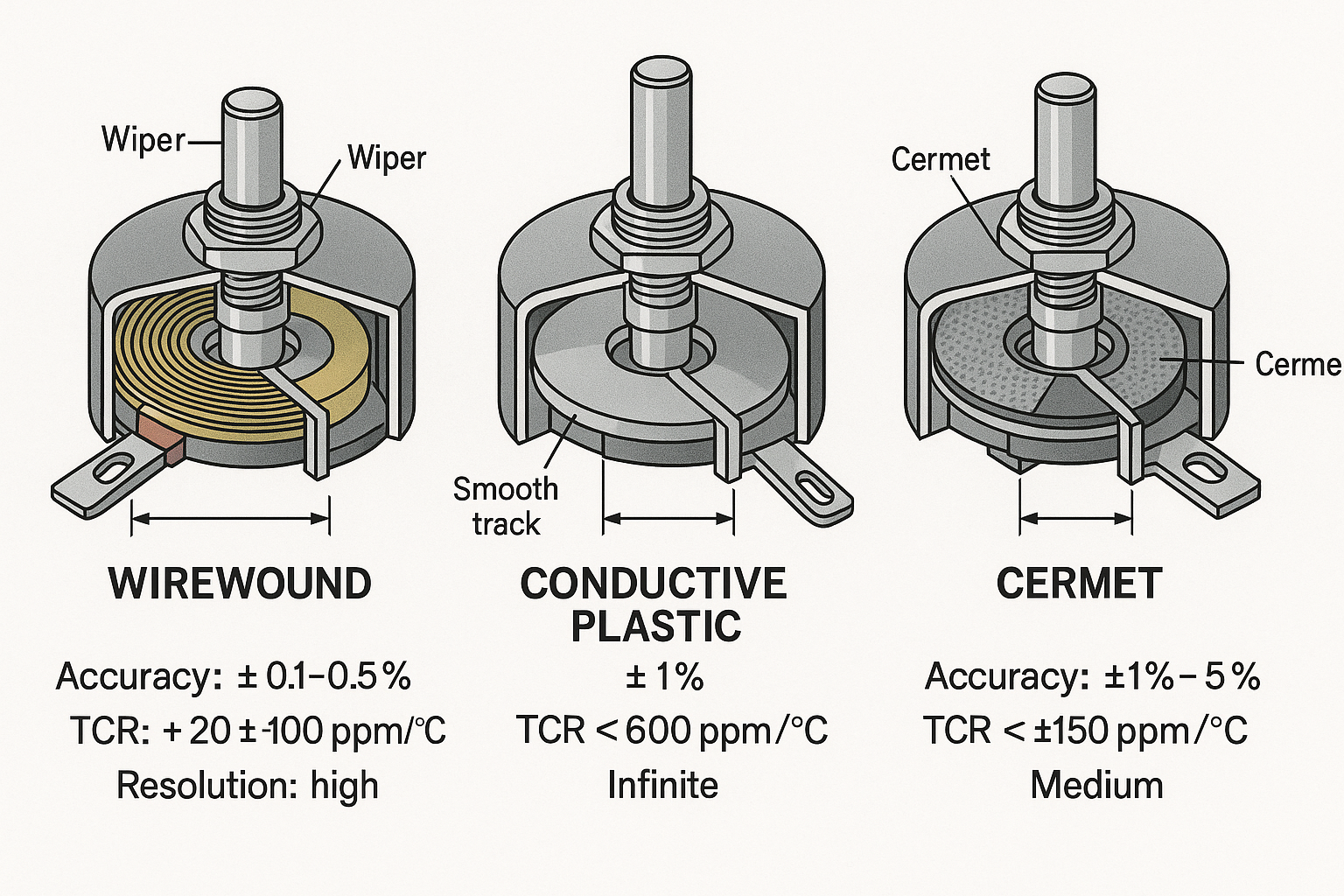
Wirewound Precision Potentiometers
Wirewound potentiometers represent the gold standard for many precision applications. These devices utilize resistance wire wound around a mandrel, offering superior linearity typically ranging from 0.05% to 0.25%. The resistance wire, often made from materials like Nichrome or specialized alloys, provides excellent temperature stability with coefficients as low as ±20 ppm/°C.
The construction involves precisely winding resistance wire with diameters typically ranging from 0.1mm to 0.5mm. This creates discrete resistance steps as the wiper contacts individual wire turns, which can be both an advantage and limitation depending on the application.
Advantages of Wirewound Types:
- Exceptional linearity and accuracy
- Superior temperature stability
- High power handling capability
- Excellent long-term stability
- Resistance to environmental factors
Limitations:
- Discrete resolution limited by wire diameter
- Potential for contact noise between wire turns
- Higher cost compared to other technologies
Conductive Plastic Potentiometers
Conductive plastic technology revolutionized precision potentiometer design by offering virtually infinite resolution with smooth, continuous adjustment. These devices achieve rotational life cycles exceeding 100 million operations compared to 10,000-50,000 cycles for standard carbon composition types.
The conductive plastic element consists of a specialized polymer matrix embedded with conductive particles. This creates a homogeneous resistive surface that eliminates the discrete steps inherent in wirewound designs.
Cermet Precision Potentiometers
Cermet (ceramic-metal) potentiometers represent a hybrid approach, combining advantages of wirewound and conductive plastic technologies. These devices offer good resolution, moderate cost, and excellent resistance to environmental factors including humidity and temperature extremes.
The cermet resistive element is created by firing a mixture of ceramic and metallic particles at high temperatures, resulting in a stable, durable resistive track.
When sourcing components for prototyping vs mass production, understanding these technology differences becomes crucial for making informed decisions about precision potentiometer selection.
Multi-Turn Precision Potentiometers for Enhanced Resolution
One of the most significant innovations in Precision Potentiometers: Achieving Accuracy in Critical Measurement Applications is the development of multi-turn designs. These sophisticated devices typically offer 3, 5, 10, or 15 turns, enabling fine adjustment resolution by spreading the full resistance range over multiple rotations.
Understanding Multi-Turn Advantages
Consider a single-turn 10kΩ precision potentiometer versus a 10-turn equivalent. The single-turn device changes resistance by approximately 28Ω per degree of rotation. The 10-turn version reduces this to just 2.8Ω per degree, providing dramatically improved adjustment precision.
This enhanced resolution proves invaluable in applications requiring:
- Calibration equipment where minute adjustments are essential
- Test instrumentation demanding repeatable settings
- Control systems requiring fine-tuned parameter adjustment
- Research applications where precision measurements are critical
Mechanical Design Considerations
Multi-turn precision potentiometers employ sophisticated gear reduction mechanisms to achieve their extended rotation range. Common approaches include:
- Worm gear systems providing smooth, backlash-free operation
- Planetary gear arrangements for compact, high-ratio designs
- Lead screw mechanisms offering linear motion conversion
The mechanical design must maintain precision throughout the extended rotation range while providing consistent torque and smooth operation. Quality multi-turn potentiometers achieve mechanical backlash of less than 0.5 degrees.
Critical Applications Demanding Precision Potentiometer Performance
The demanding world of Precision Potentiometers: Achieving Accuracy in Critical Measurement Applications spans numerous industries where accuracy isn’t just important—it’s absolutely critical for safety, performance, and reliability.
Aerospace and Defense Applications
In aerospace applications, precision potentiometers must meet stringent military specifications such as MIL-PRF-39023 and MIL-PRF-94 for reliability. These components operate in extreme environments with temperature ranges from -55°C to +125°C while maintaining accuracy despite shock and vibration.
Critical aerospace applications include:
- Flight control surface position feedback
- Engine throttle position sensing
- Navigation system calibration
- Radar antenna positioning
- Satellite attitude control systems
Medical Device Integration
Precision potentiometers used in medical devices such as ventilators and infusion pumps must comply with IEC 60601 standards and demonstrate high reliability with failure rates below 0.1% over expected service life. The stakes couldn’t be higher—patient safety depends on these components performing flawlessly.
Medical applications requiring precision:
- Ventilator flow control systems
- Infusion pump rate adjustment
- Surgical equipment positioning
- Diagnostic instrument calibration
- Patient monitoring system controls
Industrial Instrumentation and Calibration
In industrial settings, precision potentiometers serve as reference standards for calibrating other instruments. Their exceptional stability and accuracy make them ideal for maintaining measurement traceability in quality control laboratories and manufacturing facilities.
Understanding what is a BOM (Bill of Materials) and how to optimize it becomes crucial when specifying precision potentiometers for critical applications, as these components often represent significant cost elements requiring careful justification.
Digital vs. Analog: The Evolution of Precision Control
The landscape of Precision Potentiometers: Achieving Accuracy in Critical Measurement Applications has been transformed by the emergence of digital alternatives. Digital potentiometers are increasingly replacing mechanical precision potentiometers in modern applications, offering programmable resistance values and elimination of mechanical wear.
Digital Potentiometer Advantages
Digital potentiometers provide several compelling benefits:
- No mechanical wear – unlimited adjustment cycles
- Programmable control via microcontroller interfaces
- Memory storage of resistance settings
- Remote adjustment capability
- Integration with digital control systems
However, digital variants typically have lower resolution (256 to 1024 steps) compared to their analog counterparts, which can provide virtually infinite resolution.
Hybrid Solutions and Future Trends
Modern precision applications often employ hybrid approaches combining the best of both technologies. For example, a system might use digital potentiometers for coarse adjustment and analog precision potentiometers for fine-tuning.
The future trends in electronic component manufacturing and sourcing suggest continued evolution toward smart, connected precision components that can self-calibrate and report performance data.
Linearity, Resolution, and Performance Optimization
Linearity error, expressed as a percentage of full-scale output, represents a key performance metric for precision potentiometers. High-precision units achieve independent linearity of ±0.05% or better through careful design and manufacturing processes.
Understanding Effective Resolution
The effective resolution of a precision potentiometer is determined by both the theoretical resolution of the resistive element and practical factors including contact noise. Wirewound types are limited by wire diameter, typically creating 0.1mm to 0.5mm discrete steps.
Factors affecting resolution:
- Resistive element construction
- Wiper contact design and materials
- Mechanical precision of adjustment mechanism
- Electrical noise characteristics
- Temperature stability
Hybrid Precision Technologies
Hybrid precision potentiometers combine multiple resistive technologies in a single unit to optimize performance characteristics. A common approach uses wirewound elements for the main resistance range and conductive plastic for fine adjustment, providing both accuracy and smooth resolution.
When considering OEM vs aftermarket components, precision potentiometers often require OEM-grade specifications to meet critical application requirements.
Selection Criteria and Application Guidelines
Choosing the right precision potentiometer for Precision Potentiometers: Achieving Accuracy in Critical Measurement Applications requires careful consideration of multiple factors beyond basic resistance values.
Environmental Considerations
Temperature range represents a critical selection factor. Standard precision potentiometers typically operate from -25°C to +85°C, while military-grade variants extend this to -55°C to +125°C. The temperature coefficient specification becomes crucial for applications experiencing wide temperature variations.
Environmental factors to evaluate:
- Operating temperature range
- Humidity exposure levels
- Shock and vibration requirements
- Chemical exposure potential
- Altitude and pressure variations
Electrical Specifications
Beyond basic resistance values, several electrical parameters require careful consideration:
- Power rating and maximum voltage
- Noise characteristics and contact resistance
- Frequency response for AC applications
- Insulation resistance between terminals
- Dielectric strength for high-voltage applications
Mechanical Requirements
The mechanical interface often determines potentiometer selection success:
- Shaft configuration and mounting requirements
- Torque specifications for manual adjustment
- Rotational life expectations
- Adjustment speed and frequency requirements
- Environmental sealing needs
Understanding ESG and ethics in electronics sourcing becomes increasingly important when selecting precision components from responsible manufacturers.
Installation, Calibration, and Maintenance Best Practices
Proper installation and maintenance are crucial for realizing the full potential of Precision Potentiometers: Achieving Accuracy in Critical Measurement Applications. Even the highest-quality precision potentiometer can fail to meet performance expectations without proper handling and setup.
Installation Guidelines
Mechanical mounting requires careful attention to avoid introducing stress that could affect performance:
- Ensure proper shaft alignment to prevent binding
- Use appropriate coupling methods for rotational connections
- Avoid over-tightening mounting hardware
- Provide adequate clearance for thermal expansion
- Implement proper grounding and shielding techniques
Calibration Procedures
Initial calibration should be performed using traceable reference standards:
- Warm-up period – Allow stabilization at operating temperature
- Multi-point verification across the adjustment range
- Linearity assessment using precision measurement equipment
- Temperature coefficient verification if required
- Documentation of calibration results and traceability
Preventive Maintenance
Regular maintenance ensures continued precision performance:
- Periodic calibration verification according to application requirements
- Environmental monitoring of operating conditions
- Contact cleaning using appropriate solvents when necessary
- Mechanical inspection for wear or damage signs
- Performance trending to identify gradual degradation
Conclusion
Precision Potentiometers: Achieving Accuracy in Critical Measurement Applications represents a sophisticated field where mechanical precision meets electrical excellence. These remarkable components continue to enable breakthrough achievements in aerospace, medical devices, instrumentation, and countless other critical applications where accuracy isn’t just important—it’s absolutely essential.
As we’ve explored throughout this comprehensive guide, the choice between wirewound, conductive plastic, cermet, and digital technologies depends on specific application requirements. Understanding the trade-offs between accuracy, resolution, environmental tolerance, and cost enables informed decisions that optimize system performance.
The evolution toward hybrid solutions and smart, connected precision components promises exciting developments ahead. Whether you’re designing life-saving medical equipment, calibrating precision instruments, or developing aerospace control systems, precision potentiometers will continue playing crucial roles in achieving the accuracy your applications demand.
Next Steps for Implementation
Ready to integrate precision potentiometers into your next project? Here’s your action plan:
- Define your accuracy requirements – Establish tolerance and linearity specifications
- Evaluate environmental conditions – Consider temperature, humidity, and mechanical stress
- Select appropriate technology – Choose between wirewound, conductive plastic, or hybrid solutions
- Plan calibration procedures – Establish traceability and maintenance schedules
- Source from reputable suppliers – Ensure quality and long-term availability
For comprehensive component sourcing support and technical expertise, consider partnering with experienced electronics components suppliers who understand the critical nature of precision applications.
The journey toward precision excellence begins with understanding these remarkable components and their capabilities. Armed with this knowledge, you’re well-equipped to harness the power of precision potentiometers in your most demanding applications. 🎯
References
[1] Military Specification MIL-PRF-39023: “General Specification for Potentiometers, Variable Resistors”
[2] IEC 60601 Standard: “Medical electrical equipment – General requirements for basic safety and essential performance”
[3] Institute of Electrical and Electronics Engineers: “Precision Potentiometer Design Guidelines”
[4] International Standards Organization: “Temperature Coefficient Measurement Standards for Precision Components